International Journal of Agricultural Science and Food Technology
Outline of Biological Effects, Fecundity, Eclosion and Lifespan on Adult Tropical Warehouse Moth, Cadra cautella (Lepidoptera: Pyralidae) by using Sex Ratio
1Plant Protection Department, College of Food and Agriculture Sciences, King Saud University, Riyadh, Kingdom of Saudi Arabia
2Institute of Crop Science, Chinese Academy of Agricultural Sciences, Key Laboratory of Crop Physiology and Ecology, Ministry of Agriculture, Beijing 100081, China
3Department of Agricultural Extension and Rural Society, College of Food and Agriculture Sciences, King Saud University, Riyadh, Kingdom of Saudi Arabia
Author and article information
Cite this as
Khan J, Noor MA (2016) Outline of Biological Effects, Fecundity, Eclosion and Lifespan on Adult Tropical Warehouse Moth, Cadra cautella (Lepidoptera: Pyralidae) by using Sex Ratio. Int J Agric Sc Food Technol. 2016; 2(1): 35-40. Available from: 10.17352/2455-815X.000012
Copyright License
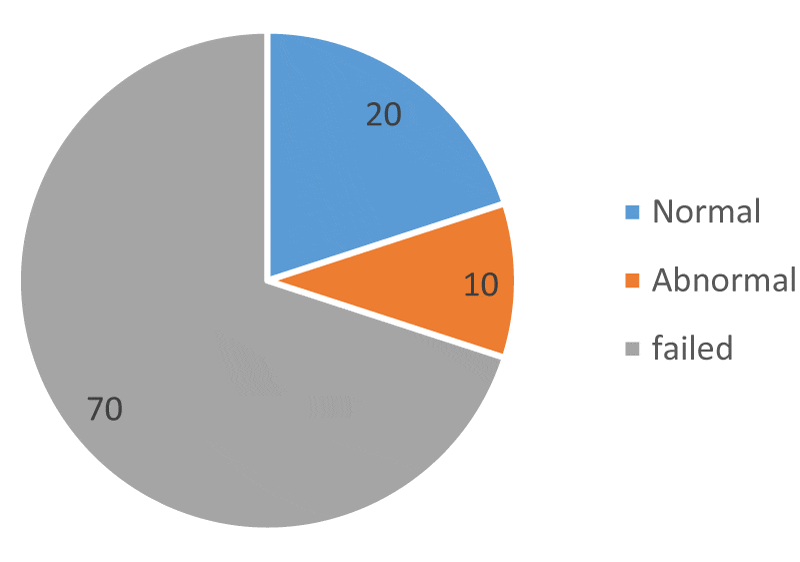
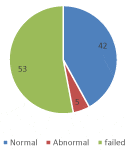
© 2016 Khan J, et al. This is an open-access article distributed under the terms of the Creative Commons Attribution License, which permits unrestricted use, distribution, and reproduction in any medium, provided the original author and source are credited.Tropical warehouse moth Cadra cautella Walker, 1863 (Lepidoptera: Pyralidae) is a major pest of stored food products worldwide. It is originated from the tropics and subtropics but it disperses through imported food cargoes. The biological performance, fecundity, eclosion (emergence of larvae from egg or adult from pupae) and lifespan of adult Tropical warehouse moth at different sex ratio (female: male) was studied under constant conditions. Fecundity and eclosion larvae investigated by fi ve treatments: sex ratio (1F:1M, 2M, and 3M), (1M: 2F, 3F) and one more treatment of separated male and female as a control for lifespan. Eclosion adult measured by collecting 350 pupae in different aged 200 male and 150 female. 1M: 3F treatment have the highest number of eggs and the least percentage of hatching to larvae and 2M: 1F and 3M: 1F treatments non-signifi cantly behaved between them having the least number of total eggs and the maximum number at total eggs per female, in both have a larger percentage of hatching to larvae respectively. Lifespan of male was signifi cant with all treatments except 1M: 3F and lifespan of female was non-signifi cant with all treatments. Eclosion of adults calculated as three levels of normal, abnormal and not emerged; for female 42% normal, 5% abnormal, 53% not emerged out of 150 pupae and for male 20% normal, 10% abnormal 70% not emerged out of 200 pupae.
Tropical warehouse moth; almond moth; cocoa moth; fig moth Cadra cautella Walker, 1863 (Lepidoptera: Pyralidae) is a major pest of stored food products worldwide [1]. It is originated from the tropics and subtropics but it disperses through imported food cargoes [2]. This dangerous pest of stored products is extremely found in packaged food [3]. A very serious cosmopolitan stored product pest infesting a wide variety of hosts such as maize, wheat, and other grains in stores. This specie is a poly-phagous pest that feeds on dried fruits, beans, nuts, bananas, groundnuts, dried cocoa, dried grains, pulses, tobacco, and coconut. Infestation is mainly post-harvest [4].
Sex ratio means male to female rate in population when male and females in a ratio of 1:1 that a stable strategy in a population of diploid organisms including insect [5]. Sex ratio for a population is an indicator of mating intensity [6]. Almost equal sex ratio for males and females exists in many animal species including insects [5,7-9]. The mating system have strong effects on mechanism and sex ratio in population and also may be have effects in properties of sex ratio in older ages [6]. A favor in sex ratio might occur because of many factors such as local mate competition (LMC) [10,11], birth, death and migration rates [5], edaphic factors [12], micro-organism infection [13] and inbreeding [14].
Reproduction of insects is also affected by the females mating frequency during her reproductive period [15]. C. cautella is a polyandrous, and its initial mating starts on the first day after emergence and further takes place on following days [16]. Present study was carried out to explore the biological performance of adult C. cautella at various sex ratios and pairing duration was also investigates for females and males kept together.
Materials and Methods
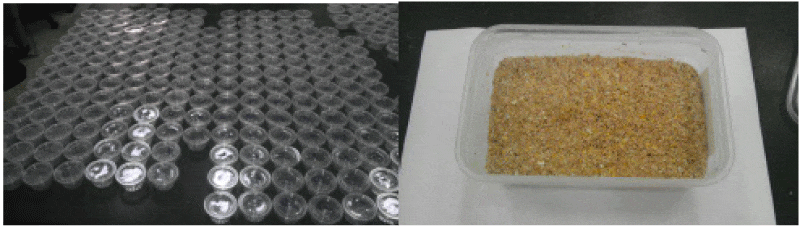
To fulfill the objectives of study, a laboratory experiment was conducted at the Economic Entomology Research Unit Laboratory, Plant Protection Department, College of Food and Agriculture Sciences, King Saud University, Riyadh, Kingdom of Saudi Arabia. A colony of tropical warehouse moth was reared on a modified diet composed of a mixture of 1 kg of crushed wheat, hen and broiler poultry feed (each 1.5 kg), and 400 ml of glycerine (Al-azab 2007). Clear-plastic, 1.3-L containers (18, 12, and 6 cm) were used for rearing. The colony and experiments were maintained at 25°C and 65% relative humidity, with a photoperiod of 16:8 L: D inside an incubator (Steridium i500, Queensland, Australia). Only newly emerged adults were used for experiments. To obtain them, pupae were removed from the colony and kept in 60-mL transparent plastic cups (7 cm diameter, 2.5 cm tall). Insects were sexed at the pupal stage and adults of each sex were kept in separate containers. For the sex-ratio experiment, groups of newly emerged adults at different sex ratios were confined until their deaths in a 310-mL plastic jar (7 cm diameter, 8 cm tall), positioned upside down. Fiber screen (1 mm2) was used to cover the rim of the jar to let eggs pass down to the 8-cm diameter plastic Petri dishes, which acted as a lid for the jar. Adults were fed by a piece of cotton soaked in sugar solution (10% w/v) that was clipped on the wall of each jar. Air circulation inside the jar was increased by seven small needle holes in the container’s walls. 5 replications of the sex-ratio experiment were performed on six treatments: normal sex ratio (1 Female: 1 Male), two male-bias sex ratios (1F:2M and 1F:3M), two female-bias sex ratios (2F:1M and 3F:1M), and virgin females alone (1F:0M) and virgin male alone also. The number of eggs, their hatching rate, and the incubation period were determined. Also, total lifespan for both males and females were recorded for the experiment. All data were obtained by daily observations starting from the time females and males were confined in the plastic jar until they died. All data analysis was conducted using SPSS version 18.
Results and Discussion
Impact of sex ratio on the fecundity of adult tropical warehouse moth
All treatments, started laying eggs in 24 hours after mating except only one treatment (2F:1M) it began setting the eggs after 48 hours. The maximum number of eggs deposition was in the 3rd, 4th and 5th day respectively (Table 1)
When we compare between total number of eggs and total eggs per one female, it is clear that treatment 3F:1M have the maximum number of total eggs and 1F:1M have the least number of total eggs and 3M: 1F have the maximum number of total eggs per female and 2F:1M have the least number of total eggs per female. It means that the population have a lot of female, it can deposit the more eggs but the minimum number of eggs per one female (Figures 1,2). On other hand the population have a lot of male, it can give the optimum number of eggs but the maximum no. per one female (3M: 1F, 2M: 1F) respectively (Figures 1,2).
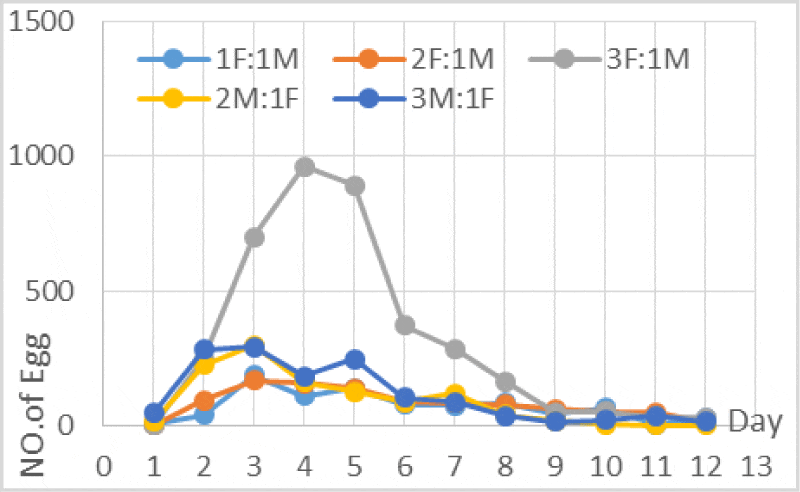
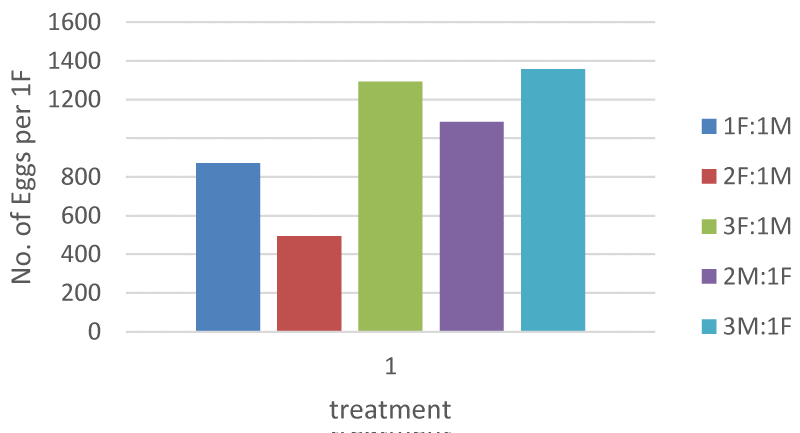
When we compare between sex ratio at total eggs and total eggs per one female, the difference between sex ratios at total eggs is very significant (P < 0.000) (Table 2). Which means there were differences between sex ratios but we cannot determine which ratios differ one or more, therefore LSD test was employed to see detailed differentiation between all ratios.
Whereas, sex ratio at total eggs per female was found non-significant (P < 0.207), which explains that no difference between sex ratios at total eggs per female (Table 3).
Although, there was no significant difference between sex ratios at total eggs per female, the LSD analysis shows a little differentiation between 3M: 1F and 1M: 2F but this difference did not affected on all the data (Table 4).
The significance between sex ratios at total eggs explained with LSD analysis (Table 5), showed that the treatment 3F:1M is fully different for all treatments, not likely the non-significance of total eggs per female in which one treatment different not effecting on total but only for treatment 3F:1M that was maximally effected on all ratios.
Impact of sex ratio on the eclosion of larvae (hatchability) of adult tropical warehouse moth
All eggs from first day hatching to larvae, except only one (3F:1M), the percentage of hatching in first day was 100%. The maximum hatching of eggs which was deposited in the 4th day, 2nd and 3th day respectively is presented in Table 6.
Comparison between total number of larvae and total number of eggs per one female showed that the treatment 3F:1M have the maximum number of total larvae and 1F:1M have the least number of total larvae and 3M: 1F have the maximum number of total larvae per female and 2F:1M have the least number of total larvae per female. Which explained that the population have a lot of females, it can give the more larvae but the minimum number of larvae per one female (Figures 1,2). On other hand, the population have a lot of males, it can give the optimum number of larvae but the maximum number per one female (3M: 1F, 2M: 1F) respectively (Figures 3,4).
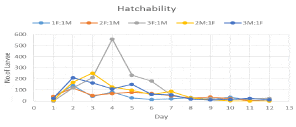
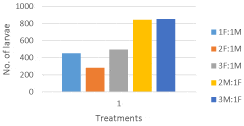
Percentage of hatch between sex ratio at total larvae and total larvae per one female, we observed that same results as described above because the percentage is constant, so difference between sex ratios was significant (P < 0.010) (Table 7).
The significant difference between sex ratios at larvae explained with LSD analysis (Table 8), showing that the treatment 1F:1M was different with 1F:2M and 2M: 1F is different with 2F:1M and 3F:1M. The 3M: 1F was found non-significant with all ratios, results declared 2M: 1F the best ratio to get a maximum number of larvae and there was no difference between 2M: 1F and 3M:1F, so we can say that if the sex ratio have more than one extra male it can give good hatching.
The percentage of emerged male and female of adult tropical warehouse moth were studied by collecting 200 male pupae and 150 female pupae, the percentage of male as a normal 20% about 39 normal male and 10% as abnormal and 70% failed to emerge. Fore females, the percentage of normal is better than males, about 42% out of 150 pupae and only 5% as abnormal and 53% not emerged (Figures 5,6).
The mean of lifespan in this experiment for male and female is 10.2 ± 0.6 and 11.2 ± 0.6 days respectively (Figure 7).
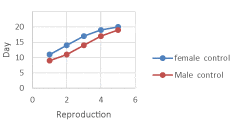
The maximum to minimum lifespan for male 19 : 9 day with mean 14.0 ± 1.8 day and 20:11 day with mean 16.2 ± 1.7 days for female (Table 9).
The significant difference for male and female in this experiment was significant. In male the control was different with all treatments except 1M: 3F and only one treatment have interaction between ratios 1M: 3F with 2M: 1F. In females, control was maximally different with all ratios, and also had one interaction between other ratios of 1M: 1F with 2M: 1F (Table 10).
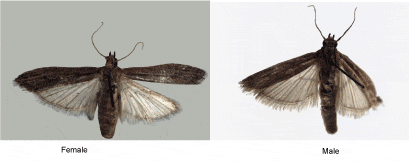
The maximum fecundity of females in this experiment was 258.6 that was very closely resembled with previous studies [17]. Sex ratios had a big difference effect on egg-deposition at total eggs of population but a very little effect at total eggs per family with similar to that of reported in other insects in family Pyralidae [18].
The maximum eggs deposition occurred on the third day [19] occurred in this study. Hatchability of eggs for the treatments which have the maximum total number of eggs reduced was found similar to that of Soffan et al. [18], with only difference in total number of eggs influenced with sex ratio.
The maximum larvae emerged on second day, egg hatchability was significantly reduced in total eggs or total eggs per female, and the strong ratios gave larvae the sex ratios of 2M:1F and 3M:1F, respectively without significance between two similar ones as reported earlier [18]. Lifespan for male and female calculated as 15.1 day in 25 °C might be same with the findings of Tunca et al. [20]. Lifespan was affected by different sex ratios are in line with earlier findings of Soffan et al. [18].
Conclusion
Results from current study explained the effects of sex ratios and pairing duration of C. cautella upon maximum egg deposition day, total eggs, hatchability and male female lifespan durations, which may help us to identify the efficiency of control techniques. Moreover, findings from present work will fortify our knowledge to optimize the rearing of C. cautella for biological control.
- Commonwealth of Australia (2004) Mangoes from India, Australian government, Department of agriculture, fisheries and forestry . Link: https://goo.gl/ZTmZf5
- Burges HD, Haskins KPF (1965) Life cycle of the tropical warehouse moth, Cadra cautella (Wlk.), at controlled temperatures and humidities. Bull ent Res.55: 775-789. Link: https://goo.gl/MEpvBw
- Navarro S, Calderon M (1972) Exposure of Ephestiacautella (Wlk.) (Lepidoptera, Phycitidae) to Low Pressures: Effects on Adults. J. Stored Prod Res 8: 209-212. Link: https://goo.gl/aQgRQB
- (ICIPE) International Centre of Insect Physiology and Ecology. Link: https://goo.gl/bzCSA6
- Sapir Y, Mazer SJ, Holzapfel C (2008) Sex ratio. 3243–3248. In Erik JS, F Brian [Eds.], Encyclopedia of Ecology. Academic Press, Oxford. Link: https://goo.gl/fNmgNj
- Weir LK, Grant JWA, Hutchings JA (2011) The Influence of operational sex ratio on the intensity of competition for mates. Am Nat 177: 167–176. Link: https://goo.gl/AaSiiH
- Myers J (1978) Sex ratio adjustment under food stress: maximization of quality or numbers of offspring? Am Nat 112: 381–388. Link: https://goo.gl/lPmcW9
- Price P W (1997) Insect Ecology. John Wiley and Sons, New York, 874. Link: https://goo.gl/Rm8wqb
- Hardy ICW (2002) Sex ratios: Concepts and research methods. Cambridge Univ Press, United Kingdom, 438. Link: https://goo.gl/mUcP0x
- Werren JH (1983) A model for sex ratio selection in parasitic wasps: Local mate competition and host quality effects. Neth J Zool 34: 81–96. Link: https://goo.gl/lZGQcX
- Paine TD, Joyce AL, Millar JG, Hanks LM (2004) Effect of variation in host size on sex ratio, size, and survival of Syngaster lepidus, a parasitoid of Eucalyptus longhorned beetles (Phoracantha spp.): II. Biol Control 30: 374–381. Link: https://goo.gl/oLR6tU
- Wrensch D, Ebbert M (1993) Evolution and Diversity of Sex Ratio in Insects and Mites. Springer. 652. Link: https://goo.gl/liKwKh
- Hiroki M1, Kato Y, Kamito T, Miura K (2002) Feminization of genetic males by a symbiotic bacterium in a butterfly, Eurema hecabe (Lepidoptera: Pieridae). Naturwissenschaften 89: 167–170. Link: https://goo.gl/pZ8Q5t
- Fauvergue X, Fleury F, Lemaitre C, Allemand R (1999) Parasitoid mating structures when hosts are patchily distributed: field and laboratory experiments with Leptopilina houlardi and L. heterotoma. - Oikos R6: 344-356. Link: https://goo.gl/gVjvwz
- McNamara KB, Elgar MA, Jones TM (2008) A longevity cost of re-mating but no benefits of polyandry in the almond moth, Cadra cautella. Behav Ecol Sociobiol 62: 1433–1440. Link: https://goo.gl/3tvc1H
- Xu J, Wang Q, He X (2008) Emergence and reproductive rhythms of Ephestia kuehniella (Lepidoptera: Pyralidae). NZ Plant Protect 61: 277–282. Link: https://goo.gl/8wqImN
- Marouf A, Maafi MA, Shayesteh N (2013) two-sex life table analysis of population characteristics of almond moth, Cadra cautella (Lepidoptera: Pyralidae) on dry and semi-dry date palm varieties. J Crop Prot 2: 171-181 Link: https://goo.gl/uMRlMX
- Soffan A, Aldryhim YN, Aldawood AS (2012) Effects of Sex Ratio and Pairing Duration on the Biological Performance of Adult Almond Moth, Ephestiacautella (Walker) (Lepidoptera: Pyralidae). Journal of Agricultural and Urban Entomology 28: 25-33. Link: https://goo.gl/AT3pLb
- Legaspi JC, Baez I, Legaspi BC Jr. (2009) Reproduction, longevity, and survival of Cactoblastis cactorum (Lepidoptera: Pyralidae). Ann Entomol Soc Am 102: 445–449. Link: https://goo.gl/A2kYZo
- Tunca H, Özkan C, Klincern (2010) Temperature dependent development of the egg-larval parasitoid Chelonuso culator on the factitious host, Ephestia cautella. Turk J Agric For 34: 421-428. Link: https://goo.gl/cPFri7



 Save to Mendeley
Article Alerts
Subscribe to our articles alerts and stay tuned.
 This work is licensed under a Creative Commons Attribution 4.0 International License.