International Journal of Agricultural Science and Food Technology
Sorption and Desorption Behaviour of Methylene Blue in Crosslinked Alginic Acid Hydrogels: A Pilot Study for Controlled Drug Delivery
Department of Chemistry, PRNSS College Mattanur, Kannur-670702, Keralam, India
Author and article information
Cite this as
Mouvenchery YK. Sorption and Desorption Behaviour of Methylene Blue in Crosslinked Alginic Acid Hydrogels: A Pilot Study for Controlled Drug Delivery. Int J Agric Sc Food Technol. 2026; 12(3): 31-38. Available from: 10.17352/2455-815X.000234
Copyright License
© 2026 Mouvenchery YK. This is an open-access article distributed under the terms of the Creative Commons Attribution License, which permits unrestricted use, distribution, and reproduction in any medium, provided the original author and source are credited.Hydrogels are three-dimensional hydrophilic polymer networks capable of absorbing large amounts of water and are widely investigated as controlled drug-delivery systems. In this pilot study, calcium-crosslinked alginate hydrogels were prepared using two calcium ion concentrations, designated Gel-0.5 and Gel-1, and evaluated for swelling behaviour, methylene blue (MB) loading, sorption isotherms, and drug release. The hydrogels exhibited pH-dependent swelling, with the highest swelling ratio observed under alkaline conditions, consistent with increased ionization of alginate carboxyl groups and expansion of the polymer network. Although the two formulations showed similar swelling and MB-loading behaviour, MB encapsulation efficiency varied with the applied drug concentration, suggesting concentration-dependent interactions between MB and the hydrogel network. Sorption data fitted well to the Freundlich isotherm model, with high coefficients of determination and favourable sorption parameters, indicating strong MB–hydrogel affinity and multilayer sorption behaviour. Drug-release studies demonstrated a controlled, pH-dependent release profile, with the highest cumulative release observed under alkaline conditions. Gel-1 released MB more rapidly than Gel-0.5 and achieved complete desorption within approximately 11 hours under alkaline conditions. A strong positive correlation between cumulative drug release and swelling ratio indicated that hydrogel swelling and network expansion were major determinants of MB release. Overall, the results demonstrate that calcium-crosslinked alginate hydrogels are promising biocompatible matrices for the controlled delivery of cationic model drugs and provide a basis for further optimization of alginate-based drug-delivery systems.
Hydrogels represent a unique class of biomaterials characterized by three-dimensional hydrophilic polymer networks capable of absorbing and retaining large quantities of water while maintaining their structural integrity [1]. These materials are composed of natural or synthetic polymers that are either physically or chemically crosslinked to form a gel network. The high water content of hydrogels, typically ranging from 60% to 99% w/w, makes them structurally and chemically analogous to living tissues, thus conferring excellent biocompatibility and minimizing adverse biological responses [1,2]. The hydrogel technologies may be applied to hygienic products, agriculture, drug delivery system, sealing, coal dewatering, artificial snow, food additives, pharmaceuticals, biomedical applications, tissue engineering and regenerative medicines, diagnostics, wound dressing, separation of biomolecules or cell and barrier materials to regulate biological adhesions and biosensors. In addition, the ever-growing spectrum of functional monomers and macromeres widen their applicability they were used in early agricultural water adsorbents based on biopolymers through grafting of hydrophilic monomer onto starch and other polysaccharides.
Hydrogels have emerged as promising candidates for controlled drug delivery systems due to their tunability, predictable release kinetics, and capacity for incorporating hydrophilic and hydrophobic therapeutic agents [3]. The versatility of hydrogels is further demonstrated by their applications across multiple routes of administration, including oral, parenteral, pulmonary, transdermal, and ocular routes [1]. This broad applicability stems from the ability to engineer hydrogel properties such as porosity, mechanical strength, swelling behaviour, and degradation rate through rational selection of polymer composition, crosslinking density, and formulation parameters.
Alginic acid hydrogels
Among the numerous polymers employed in hydrogel fabrication, polysaccharides—particularly sodium alginate—have obtained considerable attention in the pharmaceutical and biomedical communities [2,3]. The natural abundance of alginate, derived from brown algae (Phaeophyceae), combined with its relatively low cost, established safety profile, and FDA approval as a food additive and pharmaceutical ingredient, makes it an economically viable and clinically translatable option for large-scale manufacturing of hydrogel-based dosage forms [1]. It is an anionic hydrogel and its fundamental properties such as polyelectrolytic nature, biocompatibility, biodegradability, ease of gelation, mucoadhesive properties, etc. render it suitable for drug delivery applications. Alginate hydrogels can be prepared in through various methods namely, emulsification and droplet method [1,4], extrusion and spinnerets [1], microfluidic Synthesis [2,4] and freeze-thawing and post-treatment [1].
Swelling behavior
The swelling behaviour of hydrogels is a critical parameter that governs water uptake, diffusion of solutes within the gel matrix, and the kinetics of drug release [2,3]. The equilibrium swelling ratio is defined as:
Swelling Ratio (%) = [(Ws - Wd) / Wd] × 100
where Ws is the mass of the swollen gel and Wd is the mass of the dried gel. This parameter quantifies the volume expansion of the hydrogel upon hydration and is influenced by multiple factors including polymer composition, crosslinking density, ionic strength of the surrounding medium, pH, and temperature. Lower cross-link density will lead to higher swelling ratio.
Swelling of hydrogels have great implications on structure and properties of the gel. Swelling controls the compactness of the gel matrix and hence controls the pore structure and polymer network. As the hydrogel swells, polymer chains are stretched apart and the mesh size of the network increases. This will impact on mechanical properties of the gel and processes such as drug loading and release. When mesh size becomes comparable to or larger than the hydrodynamic radius of the drug, the effective diffusion coefficient of the drug in the hydrogel increases markedly. That mean, diffusion of the drug within the gel matrix will be enhanced, resulting in easy release of the encapsulated drug molecules.
pH-Dependent Swelling: Sodium alginate hydrogels exhibit pronounced pH-responsive swelling behaviour due to the ionization of carboxyl groups on the polymer backbone [2,3]. At low pH (e.g., pH 1.2, simulating gastric conditions), carboxyl groups are largely protonated (–COOH), reducing electrostatic repulsion between polymer chains. Under these conditions, the gel exhibits minimal swelling, typically in the range of 50–150% depending on the crosslinking density and M/G ratio. This reduced swelling can be mechanistically understood as a protonation-driven collapse of the polyelectrolytic network, wherein loss of charge diminishes osmotic pressure gradients that would otherwise drive water uptake.
Conversely, at neutral to slightly alkaline pH values (pH 6.5–7.4, representative of small intestinal and physiological environments), carboxyl groups are fully ionized (–COO⁻), generating strong electrostatic repulsion between deprotonated polymer chains [3,4]. This electrostatic repulsion promotes network expansion and water uptake, resulting in swelling ratios often exceeding 400–600% or higher, depending on formulation. This pH-responsive behavior is exploited for site-specific drug delivery, wherein minimal swelling in the stomach minimizes premature drug release and gastric irritation, while pronounced swelling in the small intestine promotes drug release at the intended absorption site.
Temperature Effects: Temperature influences hydrogel swelling through both thermodynamic and kinetic mechanisms. Elevated temperatures may promote hydrophobic collapse of the hydrogel if the polymer exhibits lower critical solution temperature (LCST) behavior, as observed in some alginate-polymer blends [3-16]. However, in pure sodium alginate hydrogels, temperature effects on swelling are generally modest within the physiological range (30–40°C), with slight increases in swelling often observed due to increased thermal energy promoting polymer chain mobility and solvent diffusion.
Quantitative measurement of swelling involves measuring gel mass at specified time intervals after immersion in swelling media (deionized water, buffer solutions, or simulated physiological fluids) until equilibrium is reached, typically within 2–6 hours depending on gel properties.
Drug loading mechanisms and encapsulation efficiency
Drug incorporation into hydrogels can occur through two principal mechanisms: (1) Partitioning During Gelation: drugs dissolved in the sodium alginate precursor solution partition into the gel matrix as the hydrogel forms. This approach is particularly effective for hydrophilic drugs and allows for high encapsulation efficiencies. (2) Post-Synthesis Soaking: pre-formed hydrogels are immersed in drug solutions, allowing drug molecules to diffuse into and equilibrate within the gel matrix. This method is advantageous when drugs are unstable under gelation conditions or when precise control of drug loading is desired [2,3].
Methylene blue as a model drug
Methylene blue (MB), a cationic heterocyclic dye, is widely employed as a model drug in hydrogel-based drug delivery research [3,18]. The structure of MB is shown in figure 3. The following factors justify this choice:
- Optical Properties: Methylene blue exhibits strong absorption in the visible spectrum (λmax ≈ 590 nm), allowing convenient quantification by colorimetery. The Beer-Lambert law can be applied to determine MB concentration in solution: A = εbc, where A is absorbance, ε is molar absorptivity, b is path length, and c is concentration.
- Bioactivity: In addition to being a model dye, methylene blue possesses well-characterized photodynamic and antimicrobial properties, making it pharmacologically relevant to biological applications.
- Cationic Nature: The positive charge on the MB molecule allows investigation of electrostatic interactions between drug and anionic polymer, providing mechanistic insights applicable to other cationic drugs.
- Solubility: Methylene blue is highly soluble in aqueous media across a wide pH range, facilitating experimental studies.
Drug encapsulation efficiency (EE%) is calculated as:
Encapsulation Efficiency (%) = [(Initial Drug – Remaining Drug) / Initial Drug] × 100
Literature reports indicate that sodium alginate hydrogels typically achieve methylene blue loading efficiencies in the range of 65–85%, with values influenced by gelation parameters and alginate characteristics [1,3,15].
Drug Release Kinetics: The release of drugs from hydrogels is governed by complex interplay of diffusion, polymer erosion, and swelling-mediated relaxation. Several kinetic models have been developed to describe and predict drug release profiles. Conventional drug delivery systems often release drugs immediately after administration, which may reduce drug effectiveness and increase side effects. Controlled drug delivery systems are designed to release drugs at specific site and rate, improving patient compliance and therapeutic outcomes.
pH-Dependent Release: Sodium alginate hydrogels exhibit pronounced pH-dependent drug release profiles[2,3,16]. At low pH (e.g., pH 1.2), the protonation of carboxyl groups and resulting gel collapse creates a dense, less permeable network that retards drug release. Release rates at pH 1.2 are typically <10% of the total drug load within 1–2 hours, a property exploited to protect drugs from degradation in the stomach. Upon exposure to higher pH (e.g., pH 7.4 in the small intestine), the deprotonation of carboxyl groups triggers gel swelling and increased porosity, promoting rapid drug release. Release at pH 7.4 frequently exceeds 60–80% within 2–4 hours, achieving the desired therapeutic effect at the target site.
Experimental Determination of Release Kinetics: Drug release is quantified by immersing hydrogel beads in a sink condition medium (pH-controlled buffer or simulated body fluid) maintained at 37°C under gentle agitation [3,18]. At specified time intervals (e.g., 0.5, 1, 2, 4, 8, 24 hours), aliquots of the release medium are withdrawn and replaced with fresh medium (to maintain sink conditions). The drug concentration in withdrawn samples is quantified by colorimetry, and cumulative release is calculated as a percentage of total drug content. The data are then fitted to kinetic models to elucidate release mechanisms and parameters.
Given the extensive literature supporting sodium alginate hydrogels as effective drug delivery vehicles, and considering the well-characterized pH-responsive and tunable properties of calcium-crosslinked systems, there remains value in systematic investigation of specific formulation parameters and their effects on fundamental hydrogel properties and performance. Methylene blue, while simple, remains a valid model drug for elucidating release mechanisms in novel formulations and serves as a foundation for future loading of more complex therapeutics. We aimed at, evaluating the equilibrium swelling ratios of synthesized hydrogels across a range of pH values (pH 4, 7 and10), determination of drug loading efficiency and drug content of methylene blue-loaded alginate hydrogels using multiple soaking concentrations and post-synthesis loading methods and characterizing the kinetics and mechanisms of methylene blue release from loaded hydrogels in physiologically relevant media (pH 4, 7 and 10) and fit release data to established kinetic models.
Materials and methods
Sodium alginate, methylene blue, calcium chloride and buffer solutions were purchased from Nice Chemicals, Chennai, India.
Preparation of hydrogel: Two sets of sodium alginate suspensions were prepared in deionised, distilled water (2g in 100 mL water – 2 % w/v), using a magnetic stirrer. This was added to 0.5 % and 1% solutions (20 mL) of calcium chloride separately, with constant stirring. This would result in alginate:cross-linker ratio of 20:1 and 10:1, respectively. It was allowed to rest at room temperature for one hour, to complete gelation. A jelly-like layer was formed at the bottom of the beaker and any excess solution was poured out. The hydrogel was then washed with distilled water.
Swelling ratio measurement: The formed hydrogel was dried at 50℃ for 2 hours. About 1 g of the dry hydrogels were accurately weighed and immersed in the three buffer solutions (swelling media), separately, for 24 hours. After 24 hours, excess liquid present on the gel surface was removed, gel was blotted using a blotting paper and weighed. Swelling ratio was calculated as the difference in weight of the gel before and after swelling, with respect to the dry weight.
Drug loading into hydrogel: Stock solution of methylene blue was prepared by dissolving it in water (2mL/200mL). This was further diluted to obtain five different concentrations as follows: 3mg/L, 6mg/L, 12mg/L, 24mg/L and 30mg/L. Pre-weighed (2g) hydrogels were immersed in 10 mL methylene blue solutions, separately, for 24 hours. After 24 hours, the gel materials were gently removed from the solutions and the solutions were then analysed for MB, using a colorimeter. The sorption experiments were done in triplicates. The difference in amount of MB before and after sorption would give the amount of MB sorbed onto the gel material.
Drug release testing: The hydrogels removed from MB solutions, in the previous step, were placed in 50 mL of buffer solutions, at three pH: 4, 7 and 10. 5mL of the solution was withdrawn at regular intervals (every 60 minutes, for first four hours and then after 24 hours) and replaced with equal volume of buffer solutions to maintain the volume. The MB subsamples were analysed for concentration of MB, under colorimeter.
Analysis of MB samples: Concentration of MB samples collected in sorption experiment and in desorption experiment were analysed using a calibrated (over the concentration range of 1mg/L to 20mg/L) digital photoelectric colorimeter (Systronics India Ltd., Ahmedabad), at wavelength of 590 nm. Blank correction was done using a distilled water, which was used in all the sample preparation steps.
Results and discussion
Hydrogels were prepared by crosslinking sodium alginate with calcium ions (Ca²⁺) at different concentrations. A jelly-like hydrogel was obtained under both treatment conditions, and the two formulations exhibited comparable physical appearance.
Swelling ratio analysis: Table 1 presents the swelling ratio (SR) data and corresponding calculations. The SR values ranged from 8.07% to 25.03%, which are consistent with values previously reported for similar alginate-based hydrogels [17].
The pH of the swelling medium had a pronounced effect on SR, which increased progressively from acidic to neutral and alkaline conditions. This trend can be attributed to the pH-dependent ionization of the carboxyl groups in alginate. Under acidic conditions, the carboxyl groups are predominantly protonated, reducing electrostatic repulsion between adjacent polymer chains. As a result, the polymer chains adopt a more compact conformation, producing a denser hydrogel matrix and limiting water penetration and diffusion into the network.
In contrast, increasing the pH promotes deprotonation of the carboxyl groups, generating negatively charged carboxylate ions. The resulting electrostatic repulsion expands the polymer network, increases its porosity and mesh size, and facilitates greater water uptake. Consequently, the higher SR observed at neutral and alkaline pH reflects enhanced swelling of the ionized alginate network.
It is noteworthy that the two hydrogel formulations, which differed in calcium ion crosslinking concentration, did not show a significant difference in SR at any pH. This finding contrasts with the expectation that a higher crosslinker concentration would produce a more compact gel matrix and, consequently, a lower SR.
A possible explanation is that the calcium ion concentration may have already exceeded the minimum gelation threshold at 0.5% (w/v), resulting in the formation of a sufficient number of “egg-box” junction zones within the alginate network. Under these conditions, additional Ca²⁺ may not substantially alter the crosslinking density or network structure [18]. Therefore, the comparable SR values observed for Gel-0.5 and Gel-1 may indicate that the hydrogels had reached a similar degree of calcium-mediated crosslinking, with no appreciable further compaction of the polymer matrix at the higher Ca²⁺ concentration.
Drug loading experiment
Loading of methylene blue (MB): The equilibrium concentrations of methylene blue (MB) remaining in solution after 24 hours of contact with the two hydrogel formulations were determined colorimetrically at a wavelength of 590 nm. The amount of MB loaded into each hydrogel at each applied concentration was calculated as the difference between the initially added amount and the amount remaining in solution at equilibrium, as presented in Table 2. The percentage encapsulation efficiency (EE) was calculated as the percentage of MB loaded into the hydrogel relative to the initially added amount.
The amount of MB loaded into the hydrogels at different applied concentrations is shown in Figure 1. For both Gel-0.5 and Gel-1, the amount of MB loaded increased with increasing initial MB concentration. At low applied concentrations, up to 0.1 mg/g, the increase in loaded amount was relatively small, with slopes of 0.03 for both Gel-0.5 and Gel-1. However, at higher applied concentrations, the relationship between the applied and loaded amounts became stronger, with slopes of 0.50 for Gel-0.5 and 0.52 for Gel-1.
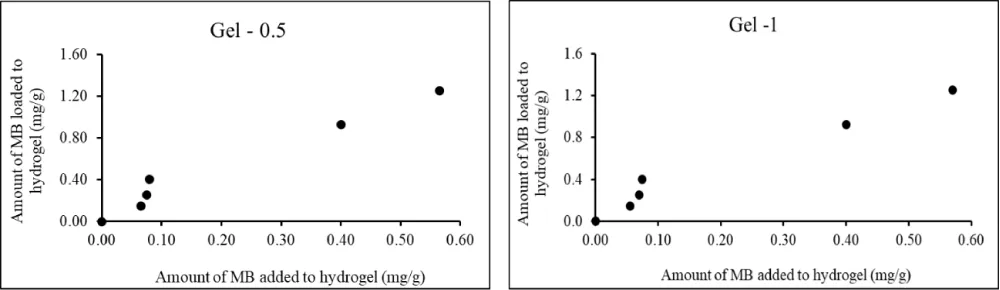
These results suggest that MB uptake by the hydrogels became more efficient at higher applied concentrations, particularly around 0.40 mg/g. Both hydrogel formulations exhibited a similar loading pattern, indicating comparable MB-loading behavior. This similarity may be attributed to the limited effect of the higher calcium ion concentration on the crosslinking density and network structure of the hydrogels, as discussed previously.
Encapsulation efficiency (EE): Encapsulation efficiency (EE), calculated as the percentage of methylene blue (MB) loaded into the hydrogels relative to the initially added amount at each concentration, is shown in Figure 2.
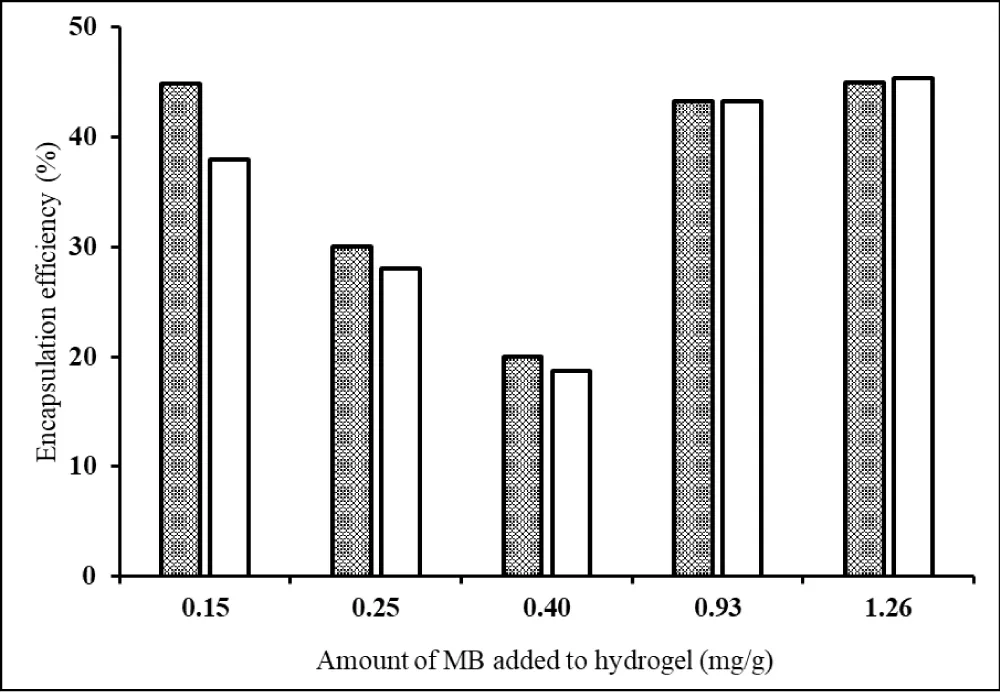
The encapsulation efficiency (EE) values initially decreased with increasing MB concentration, from approximately 45% to 20% for both Gel-0.5 and Gel-1, up to an applied MB concentration of 0.40 mg/g. However, at concentrations above 0.40 mg/g, EE increased markedly, reaching approximately 45%.
The decrease in EE at lower MB concentrations, followed by an increase at higher concentrations, suggests that the interaction between the hydrogel and MB may differ across concentration ranges. The opposing trends observed at low and high MB concentrations indicate a possible change in the dominant loading mechanism or in the availability of binding sites within the hydrogel network.
Notably, both hydrogel formulations exhibited very similar EE profiles. This finding further supports the conclusion that the difference in calcium ion concentration used during crosslinking did not produce a substantial difference in the gel properties or in their MB-loading behaviour.
Sorption isotherms: To better understand the concentration dependence of MB loading and the nature of the interaction between the hydrogels and MB, sorption isotherms were generated, as shown in Figure 3.
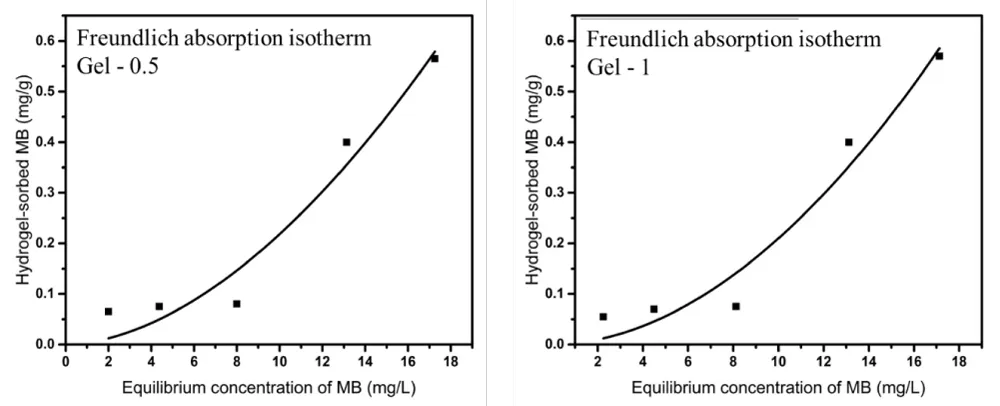
A non-linear increase in MB sorption was observed with increasing equilibrium MB concentration. The experimental data were fitted to the most commonly used isotherms (Langmuir, BET and RPI; data not shown). Among the tested models, the Freundlich isotherm model (Equation 1), demonstrated the best with highest coefficient of determination (R2 = 0.9532 and 0.9586 for Gel-0.5 and Gel-1, respectively) and lowest error values, as assessed by χ2 (Figure 3). This finding is also consistent with previous reports, in which the Freundlich model has been widely used to describe sorption behaviour in hydrogel-based systems [19].
Where x is the amount of sorbate sorbed onto the sorbent, m is the mass of the sorbent material and C is the concentration of sorbate in the solution at equilibrium. k and 1/n are sorption coefficients which indicates sorption capacity and favourability respectively.
The Freundlich model describes an increase in sorption with increasing sorbate concentration, without reaching a clear saturation limit. This behavior is often associated with multilayer sorption onto a heterogeneous surface.
In the Freundlich equation, k reflects the sorption capacity of the adsorbent; a higher k value indicates a greater capacity to retain solute at a given equilibrium concentration. The parameter n describes the intensity or favorability of the sorption process. A value of 1/n > 1 generally indicates favorable sorption and a relatively high affinity between the adsorbent and solute, whereas 1/n < 1 suggests less favorable sorption.
To characterize the MB sorption process further, the Freundlich constants k and 1/n were determined and are presented in Table 3.
The sorption parameters showed similar values for both Gel-0.5 and Gel-1. The relatively high k values indicate a strong sorption affinity between the hydrogels and methylene blue. In addition, 1/n values greater than 1 for both formulations indicate favorable MB sorption.
These findings suggest that both calcium-crosslinked alginate hydrogels are suitable sorbents for the model drug, MB. This is consistent with previous reports demonstrating the effectiveness of alginate-based hydrogels for the sorption of small organic molecules [20]. Therefore, the hydrogels prepared from sodium alginate using calcium ions as a crosslinker can be considered effective sorbents for methylene blue.
Drug release experiment: As described in the previous chapter, drug release was monitored hourly for the first 4 hours and subsequently at 24 hours. The results obtained are presented in Table 4.
As shown in Table 4, drug release into the different media was relatively high during the first hour and decreased in the subsequent hours. However, after 24 hours, a substantially higher amount of methylene blue (MB) was detected in the release medium compared with the amount released by the end of the fourth hour, for both hydrogel formulations and across all media.
This biphasic release pattern—characterized by an initial rapid release followed by a slower, sustained release—is commonly observed in controlled-release systems, including polymer matrices and microparticles. The rapid initial release, often referred to as the “burst effect,” is generally attributed to the dissolution and diffusion of MB loosely associated with the hydrogel surface upon initial contact with the release medium. Factors such as the high surface-area-to-volume ratio of the hydrogel and swelling of the hydrophilic polymer network may further enhance this initial release phase [21].
A plot of the amount of MB released into the medium versus time is shown in Figure 4. The cumulative release of methylene blue (MB), expressed as a percentage of the initial drug load, was plotted against time, as shown in Figure 5. Linear regression analysis indicated that cumulative drug release increased linearly with time across all pH conditions and for both hydrogel formulations.
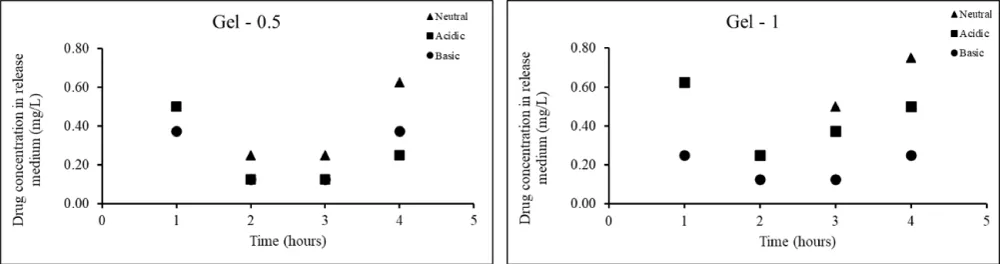
The cumulative release was higher under alkaline conditions than under acidic conditions for both Gel-0.5 and Gel-1 at all measured time points. In addition, Gel-0.5 exhibited higher cumulative release than Gel-1 at all pH values and time points.
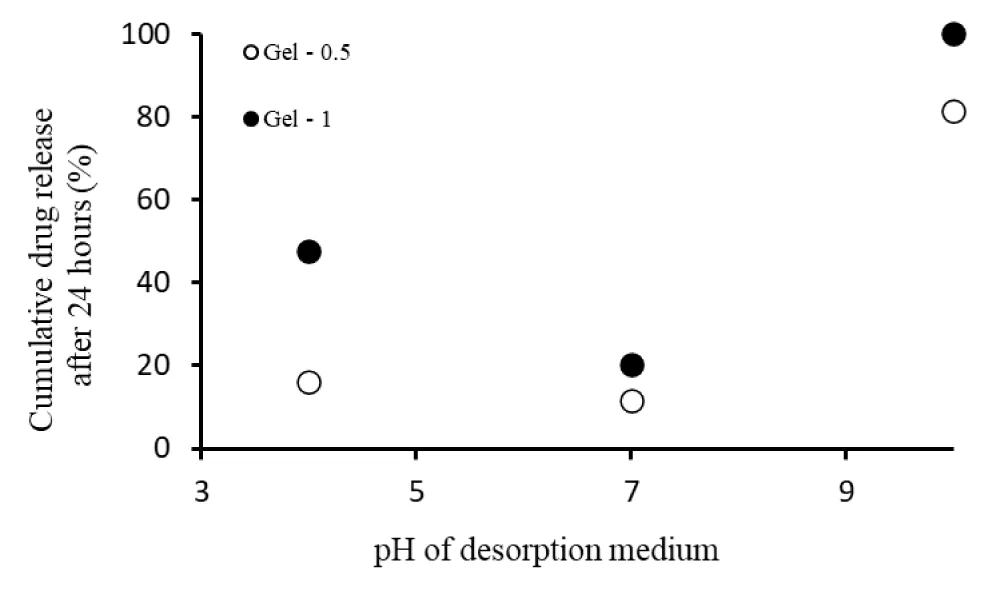
The cumulative percentage release after 24 hours is presented in Figure 6. The extent of release was clearly dependent on the pH of the release medium. For both hydrogel formulations, the highest cumulative release was observed under alkaline conditions, followed by acidic conditions, while the lowest release was observed at neutral pH. Complete drug release, corresponding to 100%, was observed for Gel-1 under alkaline conditions. This indicates that Gel-1 exhibited the greatest drug-release capacity under alkaline conditions, which more closely resemble the pH of many biological environments, among the formulations tested.
The slope values obtained from the linear fit are presented in Table 5. These values may be interpreted as indicators of the apparent desorption rate of methylene blue (MB) from the hydrogels.
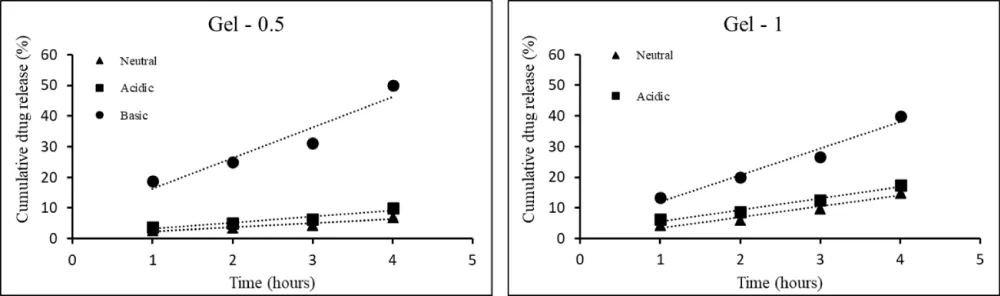
Within each hydrogel formulation, the highest slope—and therefore the highest desorption rate—was observed under alkaline conditions. Furthermore, Gel-1 exhibited higher slope values than Gel-0.5 across all three pH conditions, indicating a greater rate of MB desorption from Gel-1.
The linear pattern of cumulative release further supports the occurrence of controlled drug release, consistent with the previous discussion. The higher cumulative release and steeper trendline slope observed under alkaline conditions indicate that MB release was more efficient in the basic medium while still occurring in a controlled manner.
This behavior may be attributed to the effect of pH on the swelling and hydration of the hydrophilic alginate network. At higher pH, increased ionization of the carboxyl groups promotes electrostatic repulsion between polymer chains, leading to greater network expansion, enlarged pores, and more accessible diffusion pathways. Consequently, a larger fraction of MB is released under alkaline conditions than under acidic or neutral conditions.
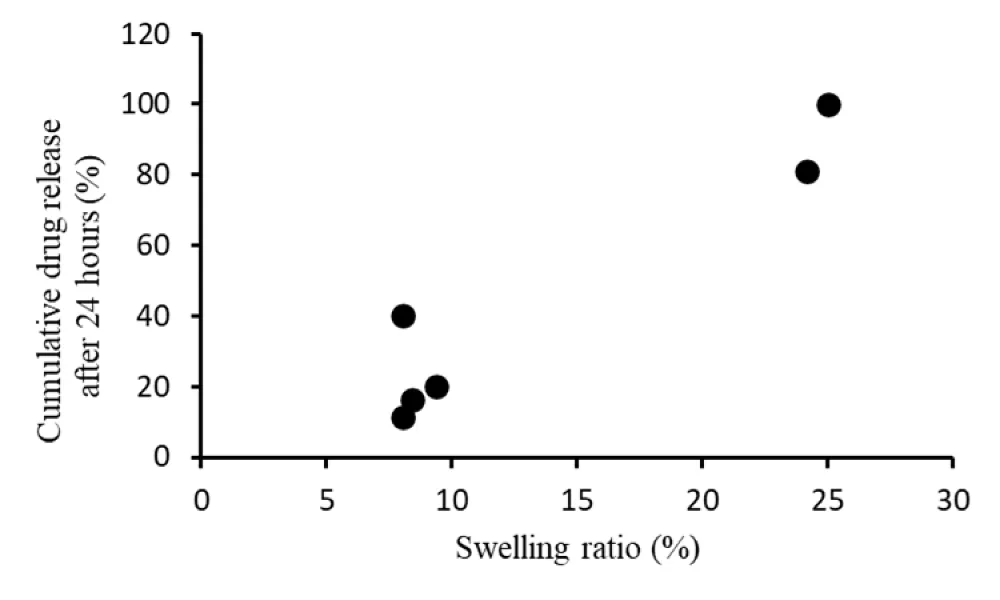
This interpretation is supported by the swelling ratio results, which showed the highest SR under alkaline conditions (Table 1 and the accompanying discussion). To further examine the relationship between hydrogel swelling and drug release, a correlation plot of cumulative desorption against swelling ratio was generated, as shown in Figure 7.
A significant positive correlation was observed between cumulative drug release and swelling ratio (SR), indicating that SR is an important determinant of MB release from the alginate hydrogels.
This relationship can be explained by the influence of swelling on the hydrogel network structure. As the hydrogel swells, the polymer chains become more separated, increasing the mesh size of the network. When the mesh size becomes comparable to or larger than the hydrodynamic radius of the drug, the effective diffusion coefficient of the drug within the hydrogel increases substantially.
At lower SR values, the polymer network remains relatively compact, restricting drug diffusion and resulting in slower and more limited release. In contrast, higher SR values indicate a more open and hydrated network, which facilitates drug diffusion and leads to faster release and higher cumulative release at a given time.
As shown in Figure 6, the cumulative release data provide information only on the extent of MB release after 24 hours and do not indicate the time at which complete desorption was achieved. To estimate the time required for each hydrogel formulation to reach 100% desorption, the release profiles in Figure 5 were extrapolated using the corresponding slope and intercept values presented in Table 5. The calculated desorption times are shown in the final row of Table 5.
According to these calculations, Gel-1 under alkaline conditions achieved 100% MB desorption within approximately 11 hours. In contrast, all other formulations required more than 24 hours to achieve complete desorption, with estimated times extending up to 70 hours.
These findings are consistent with previous reports indicating that pH-responsive alginate hydrogels may require 48–72 hours to achieve maximum drug release. The comparatively rapid complete release observed for Gel-1 under alkaline conditions may be attributed to its greater swelling and more open polymer network, which facilitate MB diffusion from the hydrogel matrix [22].
It is noteworthy that differences between the two hydrogel formulations were observed for the first time in the drug-release profiles. Although Gel-0.5 and Gel-1 showed no significant differences in swelling ratio or MB-loading behavior, they exhibited distinct release patterns.
The similarity in swelling and loading suggests that the calcium ion concentration may have already reached the threshold required for effective network formation at 0.5%. Therefore, the higher Ca²⁺ concentration used for Gel-1 may not have substantially altered the bulk crosslinking density or overall network structure.
The observed difference in release behavior may instead be explained by the presence of excess Ca²⁺ associated with the surface of Gel-1. During the desorption process, this surface-associated calcium may increase the ionic strength of the surrounding medium. A higher ionic strength can reduce electrostatic interactions between the anionic alginate network and the cationic MB molecules, thereby facilitating their diffusion into the release medium. This may account for the faster and greater MB release observed from Gel-1 compared with Gel-0.5.
Conclusions
Sodium alginate was shown to be a suitable starting material for the preparation of hydrogels, with calcium ions acting as effective crosslinkers to form stable alginic acid hydrogel networks. The swelling ratio (SR) of the hydrogels was influenced by both the hydrogel formulation and the pH of the swelling medium. The highest SR was observed under alkaline conditions, consistent with the pH-responsive behavior expected of an anionic alginate network.
The concentration-dependent encapsulation efficiency of methylene blue (MB) indicated that the interaction between MB and the hydrogels was concentration dependent and may involve different mechanisms at low and high MB concentrations. MB sorption followed the Freundlich isotherm model, suggesting multilayer sorption without a clear saturation limit. The relatively high sorption coefficients and 1/n values greater than 1 indicated strong affinity and favorable sorption of MB by both hydrogels. Similar sorption behavior between Gel-0.5 and Gel-1 further suggested that increasing the calcium ion concentration beyond 0.5% did not substantially alter the sorption capacity of the hydrogels.
The release profiles demonstrated controlled MB release from the alginate hydrogels. Cumulative release increased linearly with time, with pH- and formulation-dependent release rates. The highest release was observed under alkaline conditions, particularly from Gel-1, which achieved complete MB desorption within approximately 11 hours. The strong positive correlation between cumulative release and SR confirmed that hydrogel swelling plays a key role in regulating drug release by increasing network porosity and facilitating MB diffusion.
- Current status of alginate in drug delivery. Adv Pharmacol Pharm Sci. 2020;2020:8886095. Available from: 10.1155/2020/8886095.
- Alginate as a promising biopolymer in drug delivery and wound management. Int J Mol Sci. 2022;23(16):9035. Available from: 10.3390/ijms23169035.
- Alginate-based hydrogels and scaffolds for biomedical applications. Biomolecules. 2023. Available from: https://pmc.ncbi.nlm.nih.gov/articles/PMC10055882/
- Influence of alginate properties and calcium chloride concentration on hydrogel formation and release kinetics. Int J Pharm. 2023. Available from: https://pmc.ncbi.nlm.nih.gov/articles/PMC10610877/
- Alginate: properties and biomedical applications. 2000. Available from: https://pmc.ncbi.nlm.nih.gov/articles/PMC3223967/
- Investigation of swelling and degradation behavior of alginate beads in physiological media. J Appl Polym Sci. 2004. Available from: https://www.sciencedirect.com/science/article/abs/pii/S1381514804000161
- Adsorption kinetics of methylene blue from wastewater using pH-responsive hydrogels. Sci Rep. 2023. Available from: https://www.nature.com/articles/s41598-023-39241-z
- Release kinetics of methylene blue in Pluronic F-127 hydrogel. University of Arkansas Scholar. 2019. Available from: https://scholarworks.uark.edu/anscuht/32/
- Adsorption kinetics and thermodynamics of methylene blue by porous adsorbents. 2024. Available from: https://www.sciencedirect.com/science/article/pii/S1944398624096930
- Drug release of pH/temperature-responsive calcium alginate/poly(N-isopropylacrylamide) hydrogels. Biomaterials. 2006. Available from: https://pubmed.ncbi.nlm.nih.gov/16671051/
- Swelling behavior and mechanical stability of composite alginate-casein fibers. Macromol Mater Eng. 2025. Available from: 10.1002/mame.202500118.
- pH-sensitive chitosan/sodium alginate/calcium chloride formulations. 2024. Available from: https://www.sciencedirect.com/science/article/abs/pii/S0308814624042687
- Alginate-based hydrogels mediated biomedical applications: a review. Int J Biol Macromol. 2024. Available from: https://www.sciencedirect.com/science/article/abs/pii/S0141813024058240
- Synthesis and swelling behavior of sodium alginate/poly(vinyl alcohol) hydrogels. Turk J Pharm Sci. 2019. Available from: https://turkjps.org/articles/synthesis-and-swelling-behavior-of-sodium-alginatepolyvinyl-alcohol-hydrogels/
- Alginate-based hydrogel microparticles for drug delivery: formulation and characterization. J Pharm Biomed Anal. 2023.
- pH and temperature responsive drug delivery from calcium alginate and blended systems. Polym Chem. 2022–2024.
- A review on swelling theories of pH-sensitive hydrogels. J Intell Mater Syst Struct. 2021;32(18):2396-2415. Available from: 10.1177/1045389X21995880.
- Swelling and mechanical properties of alginate hydrogels with respect to promotion of neural growth. Max Delbrück Center for Molecular Medicine, Berlin, Germany. Available from: http://edoc.mdc-berlin.de/14020/
- Response surface methodology for optimization of methylene blue adsorption onto carboxymethyl cellulose-based hydrogel beads: adsorption kinetics, isotherm, thermodynamics and reusability studies. RSC Adv. 2019;9:37858-37869. doi: 10.1039/C9RA06450H.
- Current status of alginate in drug delivery. Adv Pharmacol Pharm Sci. 2020;2020:8886095. Available from: 10.1155/2020/8886095.
- Drug release patterns of controlled delivery dosage forms. In: Biopharmaceutics and Pharmacokinetics: Controlled Release Medication.
- Alginate as a promising biopolymer in drug delivery and wound healing: a review of the state-of-the-art. Int J Mol Sci. 2022;23(16):9035. Available from: 10.3390/ijms23169035.


 Save to Mendeley
Article Alerts
Subscribe to our articles alerts and stay tuned.
 This work is licensed under a Creative Commons Attribution 4.0 International License.