International Journal of Agricultural Science and Food Technology
Effect of Soil and Water Conservation Measures on Selected Soil Physicochemical Properties and Sorghum Yield at Babile District, East Hararghe Zone, Ethiopia
Oromia Agricultural Research Institute, Fedis Agricultural Research Center, Harar, Ethiopia
Author and article information
Cite this as
Fayaz B, et al. Effect of Soil and Water Conservation Measures on Selected Soil Physicochemical Properties and Sorghum Yield at Babile District, East Hararghe Zone, Ethiopia. Int J Agric Sc Food Technol. 2026; 12(2): 8-12. Available from: 10.17352/2455-815X.000231
Copyright License
© 2026 Fayaz B, et al. This is an open-access article distributed under the terms of the Creative Commons Attribution License, which permits unrestricted use, distribution, and reproduction in any medium, provided the original author and source are credited.Climate change, Soil degradation, drought, and moisture stress were the main problems for annual crop production and soil productivity in the eastern part of Ethiopia. Using moisture, physical soil, and water conservation measures improves soil water retention capacity and crop production. The study was done to evaluate the effect of SWC measures on selected soil physicochemical properties and Sorghum yield in the Lowland area of Babile district, East Harrarghe Zone, Ethiopia. The soil pH in the experimental area varied from 7.89 to 8.36, with an average value of 8.01, which is moderately alkaline. This is not a severe problem for plant growth, and better biomass and yield of sorghum were gained from tied ridges across the structures. Whereas relatively low yields were harvested from the control with no structure, which indicates a significant difference between the measures. However, the height of the plant was non-significant. Soil and water conservation with Tied ridge and level soil bund significantly improved the soil qualities (soil pH, K+, available P, SOC, TN, clay, and CEC) compared to Contour furrow and control, improving the soil properties and thereby improving sorghum yield. Tied ridge and level soil bund were recommended for the study area and the same agro ecology for sorghum production and soil moisture conservation. There, the two recommended soil and water conservation practices should be demonstrated and promoted. Further research should be done on the integration of these recommended physical soil and water conservation and biological measures with annual crop production for the study area and the same agrology.
Land degradation is a problem in the Ethiopian highlands, which have a good climate, agro ecology, and high potential soil fertility, and provide a living for nearly 87% of the people [1,2]. The removal of top fertile soil as a result of erosive rainfall and subsequent runoff is known as runoff-led soil erosion by rainfall [3]. As a result, it has emerged as the key challenge for global agricultural sustainability [4], as well as for the Ethiopian highlands. According to reports, the country’s agricultural practices are distinguished by backward production technology, small, fragmented land sizes, and insufficient land management approaches. Natural vegetation clearing, excessive cultivation, and crop waste collection are the factors that have contributed to the greatest decrease in soil organic carbon concentration [5].
Population pressure, marginal land farming, and overgrazing can all contribute to increased soil nutrient depletion, decreased agricultural production, and ultimately economic issues for the nation [6]. Due to variances in management practices and biophysical conditions, soil loss ranges from 37 to 246 t ha−1 yr−1 [7] and [8]. In addition to having a significant impact on soil removal, gully erosion causes significant damage to arable land management [9]. Have already been harmed and are no longer usable. This could result in a scarcity of farmland, particularly in the high-density agricultural [1]. However, improving soil physicochemical properties and ensuring rural livelihoods through SWC measures has recently emerged as one of the top policy priorities. Because a substantial portion of the population of the area is employed in agriculture, Ethiopia must give the greatest importance to managing its soil and water resources. However, our current understanding of soil fertility management cannot support the vast majority of farmers who depend on the soil for their livelihood, either directly or indirectly.
To stop soil erosion, farmers are currently using SWC conservation strategies throughout the country. However, because the extent of the intervention, the amount of manpower required, and the possible rewards vary by place, so does the execution [9,10]. The achievement of this research is to improve soil quality and productivity, to reduce erosion, to increase water infiltration and storage, improve air and water quality, etc. Several studies on SWC have been conducted throughout the country [11], but most of them have been conducted in the northern and eastern parts of the country, where rainfall is scarce. For the last two to 15 years, different SWC measures have been implemented through mass community mobilization led by the government in eastern Hararghe; however, the problem of soil erosion remains the greatest challenge, and the effectiveness of the SWC efforts implemented has not been adequately evaluated in the area.
Such relevant research is important because it can be used to improve land management practices in the watershed and other comparable areas of Hararghe. Therefore, assessing the effects of SWC measuring practices by taking into account various commonly used structures is critical to learning lessons for better future conservation planning. Specifically, this study focuses on assessing the impact of SWC measures on the physicochemical properties of the soil and investigating the effects of the topographic position and conservation structures on the efficacy of SWC measures in the Babile district. The objectives of the study were to evaluate the effect of SWC measures on selected soil physicochemical properties and Sorghum yield at the study area.
Materials and methods
Description of the study area
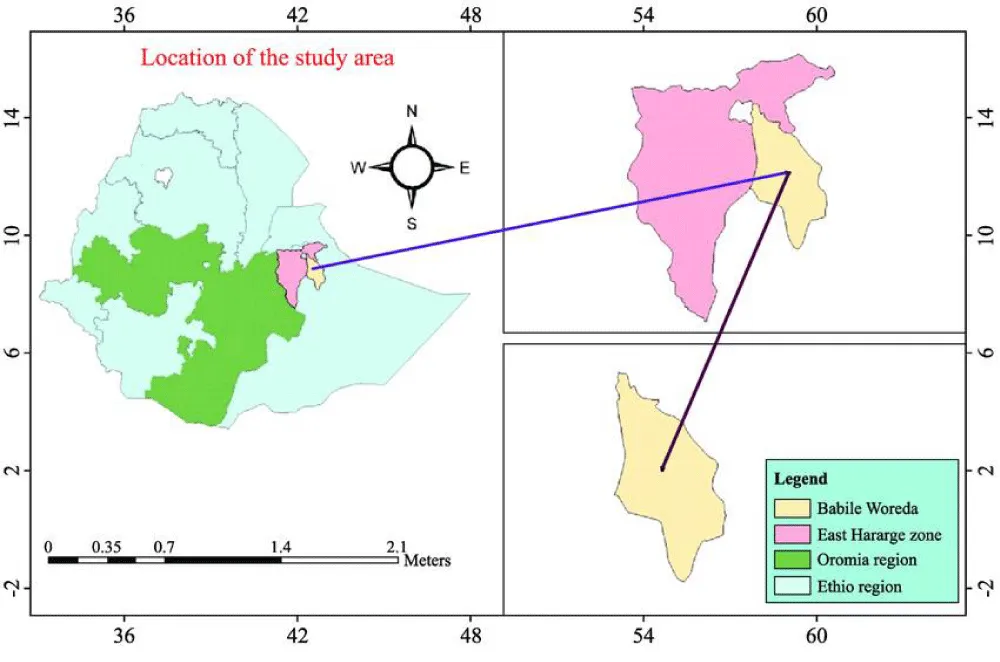
Erer station is located in Babile district, Oromia National Regional State, East Hararghe (Figure 1). It is geographically found at the latitude of 9°10’12.85”N north and longitude of 42°15’13.29”E east, in lowland areas and at an altitude of 1312 meters above sea level. The annual maximum and minimum temperatures are 26 and 20°C, respectively, and the mean annual temperature was 24°C. Mean annual rainfall of the study area in 2022 and 2023 was 795.85mm.
Experimental design and treatments
The experimental design was laid out in a randomized complete block design (RCBD) with three replications. The improved and early-maturing Melkam sorghum variety was used. The area of 30 *16 was used, and the distances between the plot and block were 1m and 2m, respectively. The experiment consisted of five treatments, four types of moisture conservation structures, and a control. The treatments were Broad bed, Level soil bund, Tied ridge, and Contour furrow. Those physical soil and water conservation structures were constructed based on the manual and Ethiopia soil and water conservation guideline, with some modification depend on the agro ecology, soil type, and topography [12].
Data collection and soil data analysis
Soil samples were collected before and after the implementation of the interventions in a zigzag movement from each plot. A total of 15 soil samples were taken at a depth of 0-30cm and composited across the interventions. The soil’s physical and chemical properties were analyzed based on standard methods. Soil organic carbon was determined by the potassium dichromate wet combustion procedure. Soil moisture content was also recorded at planting time, as well as at different growth stages of sorghum. Cation exchange capacity (CEC) was analyzed to evaluate the effectiveness of SWC measures on improving soil properties. The pH of the soil was measured in water suspension in a 1: 2.5 (soil: liquid ratio). TN content was determined by the wet oxidation procedure of the kjeldal method, and the available P content was determined by the 0.5 M sodium bicarbonate extraction procedures Olsen method. A flame photometer was used for the determination of K+. And Sorghum plant height, biomass, and grain yield were collected, recorded, and analyzed.
Method of data analysis
For each measured response, analysis of variance (ANOVA) was performed. Data was analyzed for variability using the General Linear Model of SAS version 9.1 statistical software.
Result and discussion
Effect of soil and water conservation measures on soil chemical properties
The soil pH in the experimental area varied from 7.89 to 8.36, with an average value of 8.01, which is moderately alkaline, which is not a severe problem for plant growth [3]. A maximum pH value of 8.36 was obtained on the contour furrow, and a relatively lower pH value of 7.89 for the tied ridge (Table 1). This indicates that SWC practices increase the pH of the soil and then reduce soil acidity. However, a tied ridge tends to neutrality, which could reduce alkalinity. This study agreed with those who found a relatively lower pH mean value for the loss zone (without SWC). [9] reported that pH values on the farmland terraces decreased with an increase in slope of the terrain.
Exchangeable (K+)
The soil K+ value in the experimental area varied from 444 to 508 Mg/Kg with an average value of 476 mg/kg. Which is higher based on the standard values of nutrients by [13]. Results of [14] also indicated that soils with no SWC structures are deficient in K+.
Available P (AP)
Available phosphorus (P) was different between the level soil bund and control across the structures. The maximum available P value of 14.0 ppm was found on LSB with SWC, and a lower available P value of 7.17 ppm was measured on the control without SWC. LSB and TR showed higher available P, and a lower value was observed in the control.
Soil organic carbon (SOC)
Based on the result, soil organic carbon differences between the conserved and control were different. This reveals that the physical structures done with TR (1.88) and BB (1.46) practices have a better effect on soil OM accumulation. Low OC accumulation was obtained from the control, which is 0.49. This finding agrees with [8], who assessed the effect of integrated SWC measures on key soil properties with higher soil organic matter (SOC) (3.69%) in the conserved catchment as compared to non-conserved (2.24%).
Soil moisture
Moreover, SWC measures may hold great potential for increasing SOM, thereby holding more water, which can improve the soil moisture. The moisture content for Broad bed, Level soil bund, and Tied ridge receives similar but different values for Contour furrow and control. Since the areas where these are implemented are often heavily degraded (Table 2).
Total nitrogen (TN)
The plots treated with SWC practices within the plot were found to exhibit higher total nitrogen (TN) than the non-conserved plots. TN was significant for SWC practices, and the highest content was found in the TR, BB, and LSB practices compared to CF and CC. LSB and TR showed better available TN of 0.23% and 0.18%, and a lower value of 0.01% obtained from the CC.
Cation exchange capacity (CEC)
CEC was higher in parts of SWs done with TR and LSB as compared to CF and BB. The conserved plot with LSB was found to have a higher mean CEC value of 32.52 Meq /100 g, and the lowest values of 18.85 and 16.24 for CF and CC, respectively. This result is in line with research conducted by [5] (Table 3).
Effect of soil and water conservation measures on sorghum yield and yield components
The analyzed result (2022 cropping season) shows that better biomass and yield of Sorghum were gained from tied ridges across the structures. Whereas relatively low yields were harvested from the control with no structure, which indicates a significant difference between the measures. However, the height of the plant was non-significant (Table 4).
The result (2023 cropping season) in Table 5 shows that better biomass and yield of Sorghum were gained from tied ridges across the structures. Whereas relatively low yields were harvested from the control with no structure, which indicates a significant difference between each of the SWC measures. However, the height of the plant was non-significant. The result here obtained is in line with the result gained by [9] soil and water conservation interventions.
Conclusion and recommendation
The study was conducted to evaluate the effect of different soil and water conservation practices on soil physicochemical properties and sorghum yield and yield components. The result showed that the effectiveness of soil and water conservation with a tied ridge and level soil bund significantly improved the soil properties (soil pH, K+, available P, SOC, TN, and CEC) compared to contour furrow and control. Further, the results of the soil analysis showed that most of the soil chemical properties indicate the positive impacts of SWC practices in improving the nutrient status as well as crop yield, which had significant variations with respect to moisture restoration.
Tied ridge and level soil bund were recommended for the study area, and the same agro ecology and soil type for sorghum production and soil moisture conservation. The two recommended soil and water conservation practices should be demonstrated and promoted in the study area, following Ethiopia soil and water conservation guidelines. Further research should be done on the integration of these recommended physical soil and water conservation and biological measures with annual crop production for the study area and the same agrology.
Acknowledgment
The Author would like to thank Oromia Agricultural Research Institute (OARI) for providing research funds. I would like to express my deepest gratitude to the Fedis Agricultural Research Center and Natural Resource Research Process for their support.
- Kassawmar T, Gessesse GD, Zeleke G, Subhatu A. Assessing the soil erosion control efficiency of land management practices implemented through free community labor mobilization in Ethiopia. Int Soil Water Conserv Res. 2018;6(2):87-98. Available from : https://ui.adsabs.harvard.edu/abs/2018ISWCR...6...87K
- Nyssen J, Poesen J, Moeyersons J, Deckers J, Haile M, Lang A. Human impact on the environment in the Ethiopian and Eritrean highlands—a state of the art. Earth Sci Rev. 2004;64(3-4):273-320. Available from : https://www.africamuseum.be/publication_docs/Earth-Science%20Reviews2004.pdf
- Ganasri BP, Ramesh H. Assessment of soil erosion by the RUSLE model using remote sensing and GIS: a case study of Nethravathi Basin. Geosci Front. 2016;7(6):953-961. Available from : http://www.geosciencefrontiers.com/article/doi/10.1016/j.gsf.2015.10.007
- Zerssa G, Feyssa D, Kim DG, Eichler-Löbermann B. Challenges of smallholder farming in Ethiopia and opportunities for adopting climate-smart agriculture. Agriculture. 2021;11(3):192. Available from : https://ideas.repec.org/a/gam/jagris/v11y2021i3p192-d506503.html
- Gelaw AM, Singh BR, Lal R. Soil organic carbon and total nitrogen stocks under different land uses in a semi-arid watershed in Tigray, Northern Ethiopia. Agric Ecosyst Environ. 2014;188:256-263. Available from : https://www.academia.edu/59815802/Soil_organic_carbon_and_total_nitrogen_stocks_under_different_land_uses_in_a_semi_arid_watershed_in_Tigray_Northern_Ethiopia
- Wassie SB. Natural resource degradation tendencies in Ethiopia: a review. Environ Syst Res. 2020;9(1):1-29. Available from : https://link.springer.com/article/10.1186/s40068-020-00194-1
- Admassu Z, Mekonnen K, Yirga C, Kessler A. Effect of soil bunds on runoff, soil and nutrient losses, and crop yield in the central highlands of Ethiopia. Land Degrad Dev. 2014;25(6):554-564. Available from : https://cgspace.cgiar.org/items/4958b603-a2d4-4025-a27f-bf9f2686016b
- Bojago E, Senapathy M, Ngare I, Dado TB. Assessment of the effectiveness of biophysical soil and water conservation structures: a case study of Offa Woreda, Wolaita Zone, Ethiopia. Appl Environ Soil Sci. 2022;2022(1):6910901. Available from : https://www.semanticscholar.org/paper/Assessment-of-the-Effectiveness-of-Biophysical-Soil-Bojago-Senapathy/472e1824f07e74b9d00b7a927fc415ec5af0d02d
- Belayneh M, Yirgu T, Tsegaye D. Current extent, temporal trends, and rates of gully erosion in the Gumara watershed, Northwestern Ethiopia. Glob Ecol Conserv. 2020;24:e01255. Available from : https://www.semanticscholar.org/paper/Current-extent%2C-temporal-trends%2C-and-rates-of-gully-Belayneh-Yirgu/7ab7eba670bdd5539fd7d43fa5ae3650ff335b28
- Zobisch M. WOCAT-World Overview of Conservation Approaches and Technologies. Mt Res Dev. 2002;22(1):89-90. Available from : https://www.fao.org/land-water/land/land-governance/land-resources-planning-toolbox/category/details/fr/c/1036301/
- Haregeweyn N, Tsunekawa A, Nyssen J, Poesen J, Tsubo M, Tsegaye Meshesha D, et al. Soil erosion and conservation in Ethiopia: a review. Prog Phys Geogr. 2015;39(6):750-774. Available from : https://journals.sagepub.com/doi/abs/10.1177/0309133315598725
- Hurni K. Soil Degradation and Sustainable Land Management in the Rainfed Agricultural Areas of Ethiopia: An Assessment of the Economic Implications. Ethiopia case study; 2015. Available from : https://www.greenpolicyplatform.org/case-studies/soil-degradation-and-sustainable-land-management-rainfed-agricultural-areas-ethiopia
- Gebregziabher G, Abera DA, Gebresamuel G, Giordano M, Langan S. An Assessment of Integrated Watershed Management in Ethiopia. Colombo (Sri Lanka): International Water Management Institute; 2016. Vol. 170. Available from : https://pure.iiasa.ac.at/id/eprint/14393/1/wor170.pdf
- Kato E, Ringler C, Yesuf M, Bryan E. Soil and water conservation technologies: a buffer against production risk in the face of climate change? Insights from the Nile basin in Ethiopia. Agric Econ. 2011;42(5):593-604. Available from : https://onlinelibrary.wiley.com/doi/abs/10.1111/j.1574-0862.2011.00539.x

 Save to Mendeley
Article Alerts
Subscribe to our articles alerts and stay tuned.
 This work is licensed under a Creative Commons Attribution 4.0 International License.