International Journal of Aquaculture and Fishery Sciences
Effect of phytase supplementation on labeo rohita fingerlings that are fed by phytase supplemented ddgs based diet
Department of Zoology, Wildlife, and Fisheries, University of Agriculture Faisalabad, Pakistan
Author and article information
Cite this as
Akhtar S, Zahoor I, Yahya S, Waseem N, Khan S, et al. (2020) Effect of phytase supplementation on labeo rohita fingerlings that are fed by phytase supplemented ddgs based diet. Int J Aquac Fish Sci. 2020; 6(3): 61-67. Available from: 10.17352/2455-8400.000058
Copyright License
© 2020 Akhtar S, et al. This is an open-access article distributed under the terms of the Creative Commons Attribution License, which permits unrestricted use, distribution, and reproduction in any medium, provided the original author and source are credited.Phytate is not hydrolyzed by fish because natural phytase activity not present in some agastric fishes, phytate is present in grain products as the main form of phosphorus. The present study was aimed to check the effect of phytase supplementation on muscle proximate composition in Labeo rohita fingerlings that are fed by phytase supplemented distiller’s dried grain with soluble. Six experimental diets were prepared by supplementing phytase at graded levels. D1 diet contains no supplemented phytase, while, D2, D3, D4, D5 contain 250, 500, 750, 1000, and 1250 FTU/kg phytase, respectively. The experiment continues for eight weeks. Water quality parameters including pH, temperature, and dissolved oxygen were controlled throughout the experiment. Results were analyzed through the Student-Newman-Keuls test for significant differences. Supplementation of phytase decreased the moisture and fat content of muscles in L. rohita fingerlings. Supplementation of phytase increases the crude protein and crude ash content of muscles in L. rohita fingerlings. In conclusion, phytase showed randomized responses to muscle composition.
The aquaculture sector is developing more efficiently than other food-producing industries [1]. However, the development of this industry is limited due to economic factors such as feed’s cost [1]. However, fish meal prices are tremendously increasing in the last few years, due to over-exploitation of natural fishing grounds, the availability of fish meal has been alarmingly decreased [2].
To improve the production of fish the most important feed is supplemental feed. In semi-intensive culture, artificial feed plays a major role in which a greater number of fish is needed whose natural fecundity of the water can tolerate. The entire demand for fish nutrition relies on the food that’s why the importance and function of supplemented feed in intensive fish culture could not be neglected. A by-product of the ethanol distillery industry is Distiller’s dried grains with solubles (DDGS), is less expensive on a per-unit protein basis than soybean meal. Thus, for aquaculture business, DDGS is an economical alternative of fishmeal and other plant-based proteins.
DDGS based diets were compared with a fish meal-based control diet. Fish fed 20% DDGS accumulated more body fat as compared to other to diets (control and 10% DDGS). No significant difference was observed in proximate (crude lipid, moisture contents, crude protein, and ash) composition. Similarly, no significant difference was observed in the protein digestibility coefficient. It was concluded that DDGS even supplemented with amino acids or phytase will lead to decreased weight in rainbow trout at dietary concentrations of at 10% or greater [3].
Researchers are motivated to identify economical alternatives to fishmeal due to its increasing price [4]. As DDGS content of phosphorus is low, replacement of soybean meal with DDGS will reduce the phosphorus level in the diet [5]. It reduces the discharge of phosphorus and other minerals from fish farms due to which environmental pollution is also reduced. Plant by-products that we use in fish feeds have anti-nutritional factors like phytic acid and phytate [6]. Phytate is not accessible for monogastric and agastric fishes is about 80% of total plant phosphorus content [7], which hurt the digestive ability of fish. Growth performance of fish is affected due to shortage of many elements like positively charged mineral cations, proteins, positively charged amino acids, and fatty acids as negatively charged phytate chelates with them and they become unavailable to fish ( [8].
Growth performance of agastric fishes such as Labeo rohita will be reduced if they are fed phytate rich plant ingredients, as these fishes have no natural phytase activity [6, 9,10]. Utilization and bio-availability of plant phosphorus by fish can be improved by the addition of phytase in the feed of fish. [11,12]. Microorganisms produce phytase enzymes it also found in some plant ingredients [10]. Phytate acid can be reduced by adding this enzyme in the diet [7]. Phytase improves absorption, regulation, and excretion of nutrients and hydrolyzes phytate acid to become inositol and phosphate acid [13]. In Pakistan Labeorohita commonly known as rohu is the main major carp species [6,14]. Due to disease resistance capacity, unique flavor, and rapid growth, the demand of L. rohita is dominant. The focus of this study is to determine the effect of phytase supplementation on muscle proximate composition in Labeo rohita fingerlings fed phytase supplemented distiller’s dried grain with a soluble based diet.
Materials and methods
A study conducted in the Fish Nutrition Laboratory, Department of Zoology, Wildlife and Fisheries, University of Agriculture, Faisalabad.
Methodology
Labeorohita fingerlings were brought from Government Fish Seed Hatchery, Faisalabad. They acclimatized in v-shaped (UA system) tanks, specially designed to collect feces (Figure 1), for 15 days. Each tank has eighteen fishes. The basal diet (Table 1) was given to fingerlings once in a day [15] on apparent satiation. Jenway pH meter model 3510 and D.O. meter model 970 were used to check water quality variables like pH, and dissolved oxygen. These parameters were controlled between a specific range; temp 24.9-28.7oC, DO 5.8-7.3 mg/L, and pH 7.4-8.6. The capillary system was used to give proper oxygen to every tank.
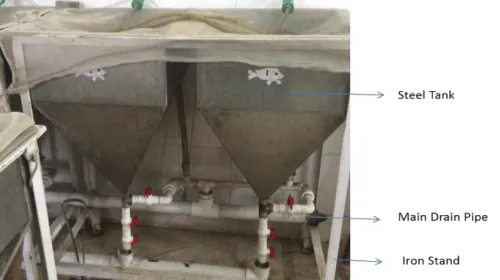
Feed ingredients and experimental diet
From the local poultry feed market, the feed ingredients were bought and before preparing the experimental diet it was subjected to chemical composition following [16]. Before adding in the experimental diet feed ingredients ground and sieved to require particle size (Table 1).
Six diets were prepared by adding phytase at levels of 0, 250, 500, 750, 1000 and 1250 FTU/kg and labeled as D1, D2, D3, D4, D5, and D6 Table 2.
Formation of experimental diet
For 10-20 minutes, all dry diet ingredients were blended in an electric mixer and fish oil was added moderately with constant stirring. As an inert marker, chromic oxide (0.5%) was added. Phytase was added at the levels of 0, 250, 500, 750, 1000, and 1250 FTU/kg to dry mixed ingredients to make six test diets. To make suitable dough of diet add ten to fifteen percent water in it and mix slowly and floating pellets were made by using lab extruder.
Feeding protocol and sample collection
Experimental diets were given to Labeorohita fingerlings at a rate of 2% of their wet weight. Replicates were assigned to each test diet. By opening the valves of each tank the uneaten diet was drained out after three hours of feeding. To remove particles of diets from tanks were washed completely and refilled. Again put the fish in the tank. After two hours by opening the valve Ι and ΙΙ of the collection tube, the feces were collected. Feces were collected carefully so that fecal string did not break because it minimizes the nutrient leaching. Then feces were dried in an oven at 60oC then crushed and lead to chemical analysis. The collection was continued until 5 g of fecal matter was collected.
Chemical analysis
In pestle and mortar, the diet sample and fish muscle sample were homogenized and subjected to standard methods [16]. The sample was dried in an oven at 105°C for 12 hours to find out the moisture content. Kjeldahl apparatus was used for crude protein, and soxhtecHT2 1045 system was used for crude fat extraction [17]. By igniting samples in an electric furnace (Eyela-TMF 3100) at 605°C for 12 hours crude ash was determined.
Dry matter
Fill the Petri dish by taking 1 g of a sample of feed and fish muscles and located in the oven for 12 hours at 105°C. Then for 5 minutes place it in desiccators and weighed. For taking constant weight again put it in the oven for 1-2 hours. Moisture was determined by the loss in weight and dry matter percentage was calculated by the following formula.
Dry matter = 100 – moisture %
Where,
W1= weight of Petri dish + sample before drying
W2= weight of Petri dish + sample after drying
Crude protein
Micro Kjeldahl apparatus was used to estimate Crude protein from feed and fish muscle samples. A digestion mixture was prepared by mixing of K2SO4, CuSO4, and FeSO4 in the proportion of 90:7:3. Take 5 g of digestion mixture, 30 ml of H2SO4, and 1 g of dried sample in Kjeldahl flask. Then the flask was kept on hot plate and heat until a transparent pure greenish solution is obtained. Cooldown the digestion material and make it diluted by the addition of 250ml of distilled water. For distillation take 10 ml of digestion mixture and 10 ml of 40% NaOH and distill with steam. Take 10 ml 2% Boric acid in a beaker and add 2 drops of methyl orange indicator and place for ammonia collection. Ammonia collected for 2 minutes after changing the color of the indicator from pink to golden yellow. Then titrate this solution against 0.1 N H2SO4. The percentage of N2 in the sample was calculated by the following formula.
Where,
0.014= Standard volume of 0.1 N H2SO4 used to neutralize 1 ml of ammonia
250= Dilution of the digestion mixture
100= for a percentage of N2
10= Volume of digestion and diluted sample used
Crude protein in the sample was calculated by the following formula
Crude protein (%) = N2 x 6.25
Crude fat extraction
Soxtec system was used for crude fat determination using petroleum ether. In Soxtec thimble, 1g of a sample is placed and attached to an adapter. At top of thimble cotton wool is placed. The thimble was inserted into the condenser. In the weighted extraction, the cup adds 50-70 ml ether and weigh it. Turn on the main switch for electricity and open water tap. The extraction cup was held strongly into the condenser. The thimble dipped in the solvent. Make sure that condenser valves were untied. The regulators of condensers were kept close during rinsing. Valves of condensers were opened and removed from the extraction cup. For drying the extraction cup with less quantity of solvent, fat or petroleum ether was located in the oven. Extraction cup put in desiccators for 5 minutes after drying and weighing. Following formula used to calculate the sample of crude fat.
Where
W1= Weight of sample (g)
W2= Weight of empty extraction cup (g)
W3= Weight of extraction cup + residue weight (g)
Statistical analysis
Following Steel, et al. [18] the data of muscle proximate were subjected to a one-way analysis of variance. By Tukey’s Honestly Significant Difference Test the differences among means were compared and considered significant at P<0.05 [19]. This Version 6.303 of Costate Computer Software was used for statistical analysis.
Results
Moisture content (%) in the muscles of Labeorohita fingerlings
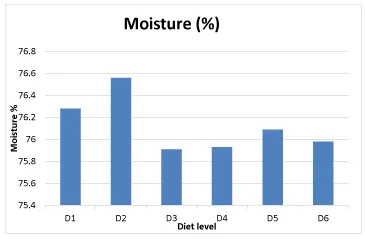
The effect of graded levels of phytase supplementation on the moisture contents in the muscles of Labeorohita fingerlings is given in Table 3. One-way analysis of variance (ANOVA) showing the effect of supplementation of dietary phytase is given in Table 4. Figure 2 shows the moisture content (%) in the muscles of Labeorohita fingerlings. The resulting data (P<0.05) showed that the supplementation of phytase decrease the moisture contents in the muscles of the Labeorohita fingerlings. The maximum decrease in moisture was observed in diet D3 containing phytase level 500 FTU/kg. While the minimum decrease in moisture content was recorded in the muscles of the Labeorohita fingerlings in diet D2 containing phytase level 250 FTU/Kg.
| Table 3: Effect of graded level of phytase supplementation on moisture content (%) in muscles of Labeorohita fingerlings. | ||
| Diet | Phytase level (FTU/Kg) |
Moisture (%) |
| D1 | 0 | 76.28a |
| D2 | 250 | 76.56a |
| D3 | 500 | 75.91a |
| D4 | 750 | 75.93a |
| D5 | 1000 | 76.09a |
| D6 | 1250 | 75.98a |
| PSE | 0.3277702702 | |
| ANOVA | P-value | |
| Phytase | 0.7072 ns | |
| Results were considered significant at p<0.05 Data are means of two replicates PSE= pooled SE=  (where MSE= mean squared error, n=number of replicates) (where MSE= mean squared error, n=number of replicates) |
||
Crude protein (%) in the muscles of Labeorohita fingerlings
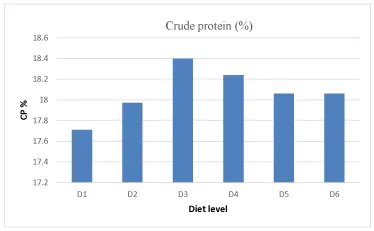
The effect of graded level of phytase supplementation on the crude protein in the muscles of Labeorohita fingerlings is given in Table 5. One way analysis of variance (ANOVA) showing the effect of supplementation of dietary phytase is given in Table 6. Figure 3 shows the protein (%) in the muscles of Labeorohita fingerlings. The resulting data (P<0.05) showed that the supplementation of phytase increase the crude protein in the muscles of the Labeorohita fingerlings. The maximum increase in crude protein was observed in diet D3 containing phytase level 500 FTU/Kg. While the minimum increase in crude protein was recorded in the muscles of the Labeorohita fingerlings in diet D2 containing phytase level 250 FTU/Kg.
| Table 5: Effect of graded level of phytase supplementation on crude protein (%) in muscles of Labeorohita fingerlings. | ||
| Diet | Phytase level (FTU/Kg) |
CP (%) |
| D1 | 0 | 17.71d |
| D2 | 250 | 17.97c |
| D3 | 500 | 18.4a |
| D4 | 750 | 18.24b |
| D5 | 1000 | 18.06c |
| D6 | 1250 | 18.06c |
| PSE | 0.0292976108 | |
| ANOVA | P-value | |
| Phytase | 0.0000*** | |
| Results were considered significant at p<0.05 Data are means of two replicates PSE= pooled SE=  (where MSE= mean squared error, n=number of replicates) (where MSE= mean squared error, n=number of replicates) |
||
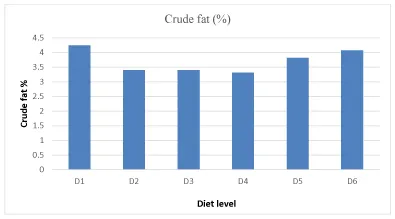
supplementation on the crude fat in the muscles of Labeorohita fingerlings is given in Table 7. One-way analysis of variance (ANOVA) showing the effect of supplementation of dietary phytase is given in Table 8. Figure 4 shows the crude fat (%) in muscles of Labeorohita fingerlings. The resulting data (P<0.05) showed that the supplementation of phytase decrease the crude fat in the muscles of the Labeorohita fingerlings. The maximum decrease in crude fat was observed in diet D4 containing phytase level 750 FTU/Kg. While the minimum decrease in crude fat was recorded in the muscles of the Labeorohita fingerlings in diet D6 containing phytase level 1250 FTU/Kg.
| Table 7: Effect of graded levels of phytase supplementation on crude fat (%) in muscles of Labeorohita fingerlings. | ||
| Diet | Phytase level (FTU/Kg) |
CF (%) |
| D1 | 0 | 4.24a |
| D2 | 250 | 3.4d |
| D3 | 500 | 3.4d |
| D4 | 750 | 3.31d |
| D5 | 1000 | 3.82c |
| D6 | 1250 | 4.07b |
| PSE | 0.0449071264 | |
| ANOVA | P-value | |
| Phytase | 0.0000*** | |
| Results were considered significant at p<0.05 Data are means of two replicates PSE= pooled SE=  (where MSE= mean squared error, n= number of replicates) (where MSE= mean squared error, n= number of replicates) |
||
Discussion
Aquaculture is developing more than any other industry in Pakistan. The availability of food for fish is the major problem of fish farmers due to the expensive rate of fish meal which used as a protein source in fish feed. The alternative of fish meal is planted by-product which also has high protein energy. Distiller’s dried grain with soluble is also a plant by-product that can be used in place of fish meal. However, DDGS have low phosphate rate in it and therefore discharge low phosphate in fish farms and reduce the environmental pollution. These plants by-product have anti-nutritional factor-like phytic acid and phytate. Monogastric and agastric fishes cannot digest this phytate and it hurts the digestibility of fish. Phytate acid can be reduced by adding phytase enzymes in the diet. Phytase improves absorption, regulation, and excretion of nutrients and hydrolyzes phytate acid to become inositol and phosphate acid. The basic purpose of our study is to make a cheap and environment pleasant fish diet that is easily available to fish farmers. We experiment on Labeorohita fingerlings which are fed on phytase supplemented DDGS based diet. We prepared six diets by adding phytase at levels of 0, 250, 500, 750, 1000 and 1250 FTU/kg and labeled as D1, D2, D3, D4, D5, and D6. Fingerlings were fed according to protocol. The results of muscle proximate analysis showed that phytase decreases the crude fat (%) and moisture content (%). While it increases the crude protein (%) and crude ash (%) in muscles of Labeorohita fingerlings.
A similar experiment was done by Tahoun, et al. [20], on fingerlings of Nile tilapia (Oreochromis niloticus). Five experimental diets with graded levels (0, 75, 150, 225, 300 mg/kg) were formulated and applied to randomly distributed fish in hapas (36 fish/hapas). The feeding trial lasts for 82 days. Finally, it was concluded that growth performance and feed utilization is significantly improved in Nile tilapia fingerlings fed on DDGS based diet supplemented up to 150 mg/kg phytase. Cheng and Hardy [21] also conducted two experiments to investigate the effect of microbial phytase supplementation in corn distiller’s grain with soluble (DDGS) on growth performance and apparent digestibility of rainbow trout (Oncorhynchus mykiss). In experiment 1 the phytase was supplemented at the levels of 0, 300, 600, 900, and 1200 FTU/kg of diet. Proximate analysis of fish indicated that the fish fed with DDGS diet supplemented with phytase were: gross energy, 50.5-66.6%; dry matter, 49.1-58.6%; minerals, 7.3-99.7%; amino acids: 73.9 to 96.8%; crude protein, 80.0-91.9% and crude fat, 78.9-88.9%. IN2nd experiment 15%DDGS based diet supplemented with methionine and lysine was used to evaluate mineral supplemental levels in rainbow trout. Six diets with trace mineral supplementation at 0.02%, 0.04%, 0.06%, 0.08% and 0.1% were formulated. Phytase was not supplemented in a control diet while supplemented at 500 FTU/kg in all other experimental diets. After 10 weeks, it was concluded that the phytase supplementation proves to be effective for releasing most trace minerals and could reduce the supplementation of trace mineral in the diet of rainbow trout.
Hung, et al. (2015) [22] prepared six diets with different levels of Di-calcium phosphate (0, 5, 10 and 15 g/kg) and fungal phytase (750 and 1500 FTU/kg) having similar content of nitrogen (320g/kg) and lipids (60g/kg). Feeding trial lasts for 3 months in which tra catfish (Pangasianodon hypophthalmus) were randomly assigned to the experimental diets. At the termination of the feeding trial, considerably higher values of protein efficiency ratio, growth performance, and phosphorus retention were shown by fish fed the diets supplemented with 750 and 1500 FTU/kg phytase and 15g/kg DCP as compared to those fed the control diet (p<0.05). A significant increase was observed in whole-body ash and phosphorus concentration of fish fed with 10g/kg and 15g/kg DCP diets than those fed on the control diet. Fish fed on phytase supplemented diets showed a higher value of apparent digestibility coefficient of phosphorus. Results suggested that growth performance, phosphorus, and feed utilization values were enhanced by phytase supplementation at 750FTU/kg and 1500 FTU/kg. Infeed of tra catfish, DCP, or other phosphorus sources can be replaced by phytase supplementation and thus phosphorus excretion is controlled, reducing the aquatic pollution. Another experiment was done by Hussain, et al. [23] to evaluate the effect of phytase supplementation on mineral digestibility and growth performance in fingerlings of Labeorohita. Seven experimental diets were formulated by adding different levels of phytase (0, 250, 500, 750, 1000, 1250, and 1500 FTU/kg) to the basal diet. Fish fed on T4 with 750 FTU/kg phytase supplementation exhibited the highest performance. Finally, resulted in data leads to conclude that 750FTU/kg phytase level diet was proved to be more effective for releasing the chelated minerals, hence increase the growth performance of L.rohita fingerlings. It was concluded that phytase supplementation in plant-based material could help reduce the mineral excretion in aqua bodies and hence reduced aquatic pollution [24-28].
Conclusion
We use plant by-products in fish feed as a source of protein however, it also contains phytate as part of phosphorus. Phytate is not hydrolyzed by fish because natural phytase activity not present in some agastric fishes. Therefore it is necessary to supply phytase enzyme artificially as natural phytase activity not present in some agastric fishes. This study aims to check the effect of phytase supplementation on muscle proximate composition in Labeo rohita fingerlings that are fed with phytase supplemented distiller’s dried grain with soluble based diet. Based on the results of existing ponders, it can be concluded that phytase has a randomized effect on muscle composition of Labeorohita fingerlings. Results were analyzed through the Student-Newman-Keuls test for significant differences. Supplementation of phytase significantly (p<0.05) decreased the moisture and fat content of muscles in L. rohita fingerlings and significantly (p<0.05) increases the crude protein and crude ash content of muscles in L. rohita fingerlings. In conclusion, phytase supplementation may improve the meat quality of Labeorohita fingerlings.
Miss Saba Malik ([email protected]) who provided technical help and writing assistance.
- Yildirim O, Acar U, Turker A, Sunar MC, Kesbic OS (2014) Effects of replacing fish meal with peanut meal on growth, feed utilization and body composition of Mozambique Tilapia fry ( Oreochromismossambicus ). Pak J Zool 46: 497-502. Link: https://bit.ly/3eGBYVU
- Lech GP, Reigh RC (2012) Plant products affect growth and digestive efficiency of culturedFlorida pompano ( Trachinotuscarolinus ) fed compounded diets. PLoS One 7: e34981. Link: https://bit.ly/2Zfk6uE
- Barnes ME, Brown ML, Rosentrater KA (2012) Juvenile rainbow trout response to diets containing distiller’s dried grain with solubles, phytase and amino acid supplementation. Open J Anim Sci 2: 69-77. Link: https://bit.ly/3eMJdeS
- Shapawi R, Ebi I, Yong A (2013) Soybean meal as a source of protein in formulated diets for tiger grouper, Epinephelusfuscoguttatus juvenile. Part I: Effects on growth, survival, feed utilization and body compositions. Agric Sci 4: 317-323. Link: https://bit.ly/2YOScHf
- Liener IE (1994) Implications of anti-nutritional components in soybean foods. Crit Rev Food Sci Nutr 34: 31-67. Link: https://bit.ly/2YHPyTw
- Baruah K, Sahu NP, Pal AK, Debnath D (2004) Dietary phytase: an ideal approach for cost effective and low-polluting aquafeed. NAGA World Fish Center Quarterly 27: 15-19. Link: https://bit.ly/31qNBfX
- National Research Council (NRC) (1993) Nutrient requirements of fish. National Academy Press, Washington, DC, USA 114. Link: https://bit.ly/2YK8ZuV
- Usmani N, Jafri AK (2002) Influence of dietary phytic acid on the growth, conversion efficiency and carcass composition of Cirrhinusmrigala (H) fry. J World Aquacult Soc 33: 199-204. Link: https://bit.ly/2NFW0nN
- Cao L. Wang W, Yang C, Yang Y, Diana J, et al. (2007) Application of microbial phytase in fish feed. Enz Microb Technol 14: 342-362.
- Hussain SM, Afzal M, Rana SA, Javid A, Iqbal M (2011) Effect of phytase supplementation on growth performance and mineral digestibility of Labeorohita fingerlings fed on corn gluten meal based diets. Int J Agric Biol 13: 916-922. Link: https://bit.ly/2YLkAK6
- Vielma J, Lall SP, Koskela J (1998) Effects of dietary phytase andcholecalciferol on phosphorusbioavailability in rainbow trout ( Oncorhynchusmykiss ).Aquaculture 163: 309-323. Link: https://bit.ly/31xaVsm
- Baruah K, Pal AK, Narottam PS, Debnath D (2007) Microbial phytase supplementation in rohu, Labeorohita diets enhances growth performance and nutrient digestibility. J World Aquacult Soc 38: 129-137. Link: https://bit.ly/38hOWab
- Chung SK (2001) Inositol phospholipid pathway inhibitors and regulators. Expert Opinion on Therapeutic Patents 11: 45-59. Link: https://bit.ly/38g5jUA
- Abid M, Ahmad MS (2009) Efficacy of feeding frequency on growth and survival of Labeorohita fingerlings under intensive rearing. J Anim Plant Sci 19: 111-113. Link: https://bit.ly/3ged1RU
- Allan GL, Rowland SJ (1992) Development of an experimental diet for silver perch (Bidyanusbidyanus). Aust Aquacult 6: 3-40.
- AOAC (Association of Official Analytical Chemists) (1995) Official Methods of Analysis. (16th Edition). AOAC, Inc. Arlington, Virginia, USA. Link:
- Bligh EG, Dyer WJ (1959) A rapid method of total fat extraction and purification. Can J Biochem Physiol 37: 911-917. Link: https://bit.ly/31u2jmd
- Steel RGD, Torrie JH, Dickey DA (1996) Principles and Procedures of Statistics, 3rd Ed. McGraw Hill International Book Co. Inc., New York. USA. Link:
- Snedecor GW, Conharn WG (1991) Statistical Methods. Lowa State Univ. Press, Ames USA.
- Tahoun AM, Abo-state HA, Hammouda YA (2009) Effect of adding commercial phytase to DDGS based diet on the performance and feed utilization of nile tilapia (Oreochromisniloticus) fingerling. American-Eurasian J Agric Environ Sci 5: 550-555. Link: https://bit.ly/31uvXIj
- Cheng ZJ, Hardy RW (2004) Nutritional value of diets containing distiller’s dried grain with solubles for rainbow trout, Onchorhynchusmykiss. J Appl Aquacult 15:101-113. Link: https://bit.ly/3ihqlqP
- Hung LT, Thanh NT, Pham MA, Browdy CL (2015) A Comparison of the effect of dietary fungal phytase and dicalcium phosphate supplementation on growth performances, feed and phosphorus utilization of tra catfish juveniles, (Pangasianodonhypophthalmus, sauvage 1878) Aquacult Nutr 21: 10-17. Link: https://bit.ly/2CNTXvu
- Hussain SM, Afzal M, Nasir S, Jabeen F, Javid A, et al. (2015) Efficacy of phytase supplementation in improving mineral digestibility in Labeorohita fingerling fed on canola meal based diets. Iranian J Fish Sci 15: 645-661. Link: https://bit.ly/31ttsG7
- Hussain SM, Afzal M, Rana SA, Javid A, Hussain M (2011) Impact of phytase supplementation on nutrient digestibility for Labeorohita fingerlings fed on sunflower meal based diets. Pak J Life Soc Sci 2: 85-90.
- National Research Council (NRC) (2011) Nutrient requirements of fish and shrimp. National Academy Press, Washington, DC, USA, 376. Link: https://bit.ly/3eMkQxZ
- Yildirim O, Acar U, Turker A, Sunar MC, Kesbic OS (2014) Effects of replacing fish meal with peanut meal on growth, feed utilization and body composition of Mozambique Tilapia fry (Oreochromismossambicus). Pak J Zool 46: 497-502. Link: https://bit.ly/3eGBYVU
- Zhou QC, Tan BP, Mai KS, Liu YJ (2004) Apparent digestibility of selected feed ingredients for juvenile cobia (Rachycentroncanadum). Aquaculture 241: 441-451. Link: https://bit.ly/2NH4oDo
- Cheng ZJ, Hardy RW (2002) Effect of microbial phytase on apparent nutrient digestibility of barley, canola meal, wheat and wheat middlings, measured in vivo using rainbow trout (Oncorhynchusmykiss). Aquacult Nutr 8: 271-277. Link: https://bit.ly/31veE9O


 Save to Mendeley
Article Alerts
Subscribe to our articles alerts and stay tuned.
 This work is licensed under a Creative Commons Attribution 4.0 International License.