Annals of Environmental Science and Toxicology
Water Footprint and Food Industry: Alcotra-Region Nexus
Researcher, Cerege Centre De Recherche Et D’enseignement Des Géosciences De L’environnement/Aixmarseille University, France
Author and article information
Cite this as
Corami A. Water Footprint and Food Industry: Alcotra-Region Nexus. Ann Environ Sci Toxicol. 2026; 10(1): 35-40. Available from: 10.17352/aest.000094
Copyright License
© 2026 Corami A. This is an open-access article distributed under the terms of the Creative Commons Attribution License, which permits unrestricted use, distribution, and reproduction in any medium, provided the original author and source are credited.The water footprint (WF) is defined as the total amount of water required to produce goods and services. This value can be determined for crop activity, but also in industrial processes, for a multi-national company, for a state or for a watershed. It is an index to assess the water necessary for agro-industrial activity.
Water is classified using three colours according to the origin and the use. Green water is defined as the water from precipitation stored in the root zone, present in plants, or evaporated water. Blue water footprint is surface water, groundwater, or evaporated water. Blue water is used in agricultural production, industry, and domestic use. The last colour is the grey water; it is the total volume of water necessary to dilute contaminants to reach a specific quality level.
Agro-industry is water-consuming, and the industry demand for freshwater is affected by climate change too. Summer 2023 and 2024 have been defined as the hottest ones among the last years, with drought, heavy precipitation and wildfire either in France and Italy.
Climate change, soil degradation, and soil salinization of irrigated areas will potentially limit future increases in production. Agricultural production needs to increase by almost 50% by 2050 to meet the rising demand for food, fibres, and biofuels. Water management is becoming very important day by day not only for crop and food production, but also for climate change. The increasing of temperature and extreme events are affecting water resource and water quality, climate change will affect crop production (soil evaporation and crop transpiration) and in a second moment agro-industry, too.
GoutteaGoutte/GocciaaGoccia (GAG; https://goutteagoccia.com) project’s goal is to help micro and small enterprises (MSMEs), involved in the agro-industrial production, to be more sustainable. Supporting these enterprises in finding a suitable and cost-effective choice according to their dimension and type of production. The project is based on three main pillars like to solve water leakage phenomenon, to reduce water during the industrial activity and to reuse the wastewater for a secondary purpose. To reuse wastewater according to the European Law (2024/1765), the French law (Decree 2024-769) and the Italian law (Decreto Siccità 31/12/2024). Reusing wastewater for a secondary purpose means to follow the circular economy principle, avoiding any waste starting from the leakages. EU supports the Circular Economy to reach the sustainability and efficiency in industrial activity.
GAG project was funded by the European Regional Development Fund (ERDF) as part of the Interreg V-A France-Italy ALCOTRA 2021-2027 Program.
GAG project is a collaboration among Chamber of Commerces Italy (Piedmont and Liguria) from PACA (Provence-Alps-Côte Azur) area, Politecnico of Torino (Italy) and Aix-Marseille University (France). The first GAG’s goal is to choose the enterprises, the second aim is to determine if there are leakages and the annual volume of water used by each enterprise. The end purpose is to create a pilot test to remediate the wastewater and later to reuse this water. The ultimate target is to support MSMEs to become more sustainable and their formation about topics like sustainability, climate change and the intensification of extreme phenomena in Southern Europe.
The demand of freshwater is increasing as the increasing of population, freshwater for agriculture and industrial activity too [1]. These data will worsen when population will grow up to 10 billion in 2050 [2]. Water is a renewable resource but its availability is not unlimited, the volume of water depends on many factors like temperatures and precipitations [3,4].
European Environment Agency (EEA) stated Europe is depleting freshwater resources, water resource is used for agriculture, manufacturing, drinking, heating, refrigeration, electricity production, tourism.
At European level freshwater resources are depleting due to population growth, urbanization, pollution, climate change and mostly the intensification of drought phenomena, particularly in Southern Europe (Mediterranean area). Drought is an effective emergency affecting agri-food chain; so, the adoption of precise and efficient measures is a key-solution [2,5].
After the period of Covid-19 pandemic, micro and small enterprises (MSMEs) faced a very intense and difficult moment. The Goutteagoutte/Gocciaagoccia project (GAG) fits in, the main idea is to sustain MSMEs to face the problem of climate change in Mediterranean area. The summer time in 2022 and 2023 were characterised by drought phenomena either in France and in Italy. The drought problem cost about 1.2 billion €/y in France with large damages to agriculture activity; water shortages is a risk particularly concerning southern France and northern Italy (ALCOTRA area1), with a warming of +2°C, more than a third of the population in this area could lack of water. It is fundamental to protect the water system, to make the system more efficient and particularly in vulnerable areas to satisfy the demand.
Climate change and pollution affect water resource; moreover, agriculture activity and agro-industrial (food industry) activity impacts the water resource system too,
The agro-industrial sector has a paramount importance in EU, interesting about 4,7 million of employs and being the leader with about 40.1% turnover for SMEs [6] resulting the predominant typology due to the different traditions and tastes, a very strong European heritage. Moreover, about 75% of food product are transformed and distributed by industry [6]. Agro-industrial production has increased from 2015, from 2021-202 its turnover in EU is quite stable, a decline was observed during Covid -19 pandemic.
Food industry covers sectors such as fruits and vegetables processing, dairy production and beverages. About 84% of companies produce drinks, meats and “various food category”.
Size of companies in this sector is highly variable, MSMEs are about 300,000, among these France, Germany, Italy and Spain are the largest EU food and drink producers. Wine and food preparations are key exports, making EU the largest exporter in the world. A sad statement is that about 59 million tonnes of food were lost or wasted in 2022, this is about 16% of GHG emissions and the level of water stress is about 8.3 % in 2018 [6].
The SDG 6 states “Ensure availability and sustainable management of water and sanitation for all” [7], and following this goal the Water Footprint (WF) was defined to determine the water volume in case of agricultural and industrial production (Hoekstra and Hung, 2002).
Anthropogenic activities consume water, as agriculture production and, later agro-industrial activity needs water, unfortunately this is a polluted waste-water with contaminants of different origin at the end of all the process. Understanding the volume of water behind a product could make us understand the importance of freshwater and the concernment in preserving the water quality and the problem in consumption without a policy to optimize it [3]. Understanding the paramount importance between consumption and use of water will be a carrier for governance of the water triggering sustainable changes. A policy from governments is to subside water supply investing in large infrastructures, but not charging the water users highlighting the non-saving water attitude. So, the production of any goods is not regulated by the water scarcity problem. The water foot print has an economic impact related to water use inefficiency
Water footprint
The concept of water footprint is the volume of freshwater used during production and/or consumption (direct use) but also an indirect use, a general definition is the total freshwater amount for the production along the supply chain. Hoekstra et al. and Hoekstra [3,8,9] defined three types of water using colours based on the origin (Figure 1). The blue water refers to surface and groundwater along supply chain of a product; the green water originates from precipitation that has infiltrated soil and increased soil moisture; the grey water is the amount of freshwater necessary to assimilate pollutants reaching the previous ambient water quality standards.
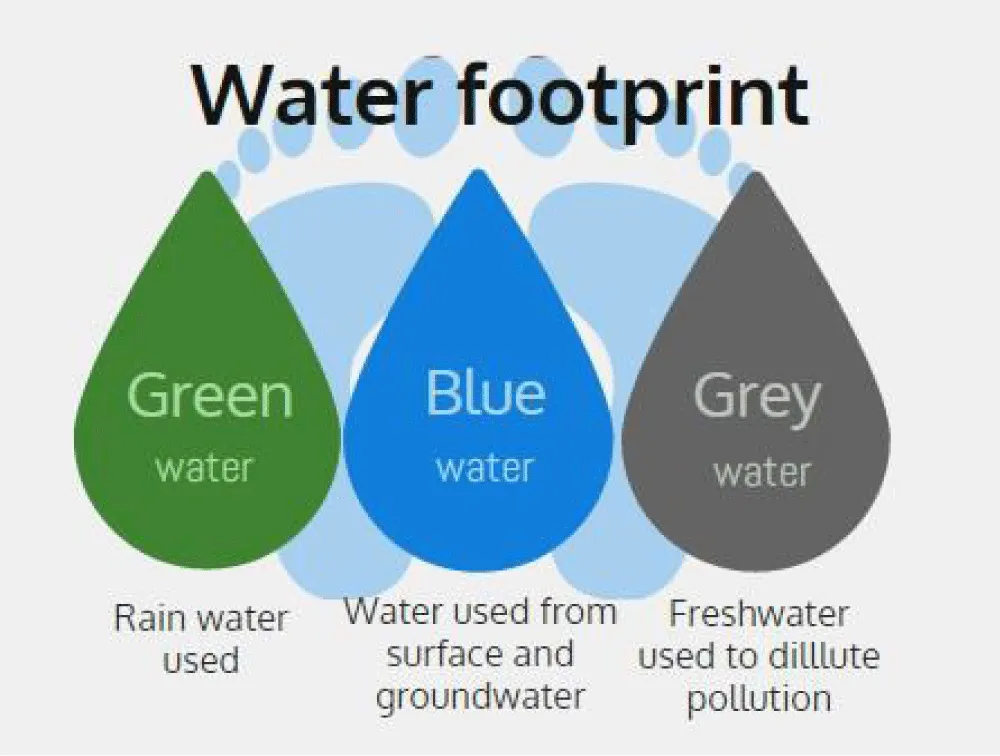
The blue water footprint is defined as a consumptive water use, this is referred to some points like water evaporates, water can return in a different catchment area or to the sea or water can return in a different time period and it could be a scarce or a wet period. The green water is referred to the infiltrated and stored water in soil, not the water which recharge the ground water system. So green water stands for water that evaporates and/or transpires, so green-water footprint is a consumed volume of water during the activity. This is relevant for the agriculture activity and later for the agro-industrial activity too [10]. The greywater footprint is defined as the necessary volume of freshwater to dilute contaminants so the water quality is as before, it can be defined as an indicator of contamination. Pollutants can be released into a surface water body and/or in a soil, in the first case the load can be measure, on the other hand in soil part of pollutants could reach groundwater system or run off, therefore the value is a partial one. Actually, the grey water footprint is an indirect measure of the load of contaminants in the water. For this reason, is of fundamental importance to state the used water quality standards in valuing this footprint [3], in particular for ambient water quality. Indeed, standards for this water are intended to define how water assimilate these chemicals.
It results as a tool to determine if the use of water is sustainable and/or equitable for a human purpose. Calculating this value, it is ideal to consider the direct and indirect water footprint. During industrial production the water footprint along the supply chain is higher than the ones from operations, so reducing the amount of water along the supply chain could be more cost-effective than making different improvements. Water footprint is a valuable tool to support industrial activity in determining the impacts on a catchment or river basin to value the sustainability assessment.
The water footprint of a product is the sum of all the water footprints of every single step:
feed crop cultivation, livestock farming
food processor, retailer consumer
This is an example of direct and indirect water footprint for each stage of the supply chain for meat production.
Water footprint for agro-industry production
The water footprint for a product is defined as the total amount of water, direct and indirect, used to produce the product, valuing the necessary water volume during the production and pollutants along the production chain [11]. Defining the water foot print instead of the virtual-water content stand for defining the type of water (blue, green grey) and not only the embedded water of the product [3], (Figure 2).
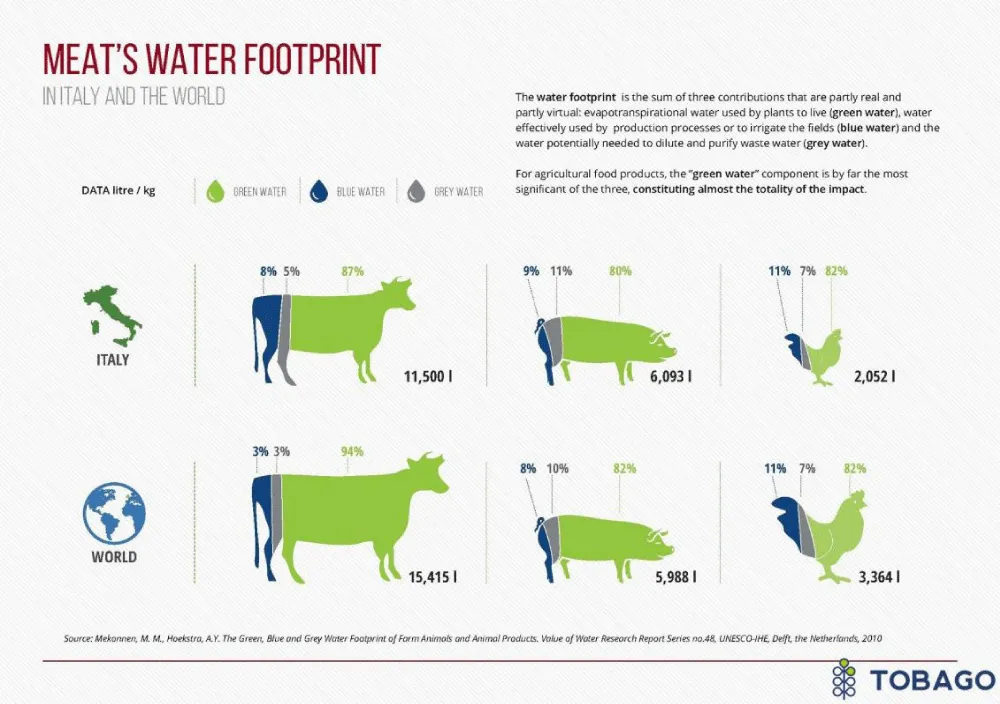
For determining the water footprint of a product any steps have to be specified from the origin till the end of production, tracing all the product ingredients. The two simplest cases are when the final product is one starting from different initial products and in this case the final datum is the sum of each water footprints. A second example is starting with one initial product and having more final products. In this last case the water footprint will be distributed among the final products. To value the water foot print of a product the best way is to determine the value step by step along the process, starting from the water footprint from the input products till the output products. In case an initial input has an origin from a different chain, the water footprint for this one ought to be obtained from the supplier. At the end of the supply-chain water footprint is composed of the three different water colours [3,12].
Water footprint and MSMEs
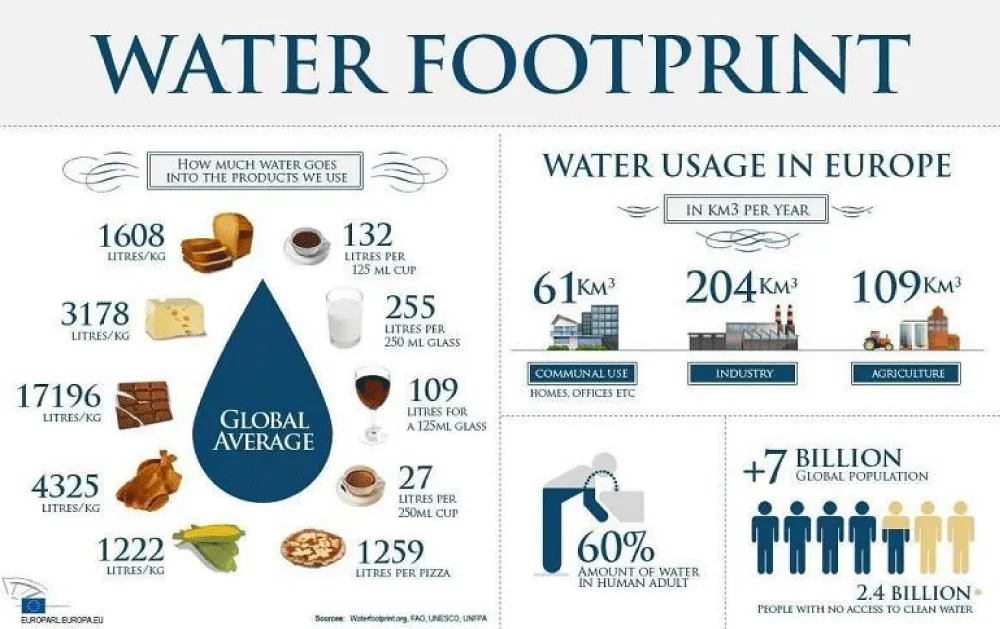
The main goal of this project is to support micro and small enterprises (MSMEs) in reducing their water foot print, reducing the volume of water during their own operations and decreasing the discharge of wastewater. A way to reach this purpose is to cut their own supply-chain water footprint through supplier’s agreement or changing supplier. Further step is to share this goal with consumers [3]. Goutteagoutte/Gocciaagoccia project (GAG) is based on supporting MSMEs in the reduction of consumptive water use during agro-industrial production and find a sustainable and efficient water-saving appliances [13,14].
Risks that these enterprises might face are a freshwater shortage affecting their production and caused by less precipitation, their image can be affect by a lack of sustainability due to the large use of water, problem about pollutants and the amount of discharged wastewater in the environment. These risks are also a very important financial one. (Figure 3).
GAG project advancing MSMEs
This project is an Interreg2 ALCOTRA3 programme between two areas, France and Italy (Alpes-de-Haute-Provence, Alpes-Maritimes, Cuneo, Imperia). (Figure 4).
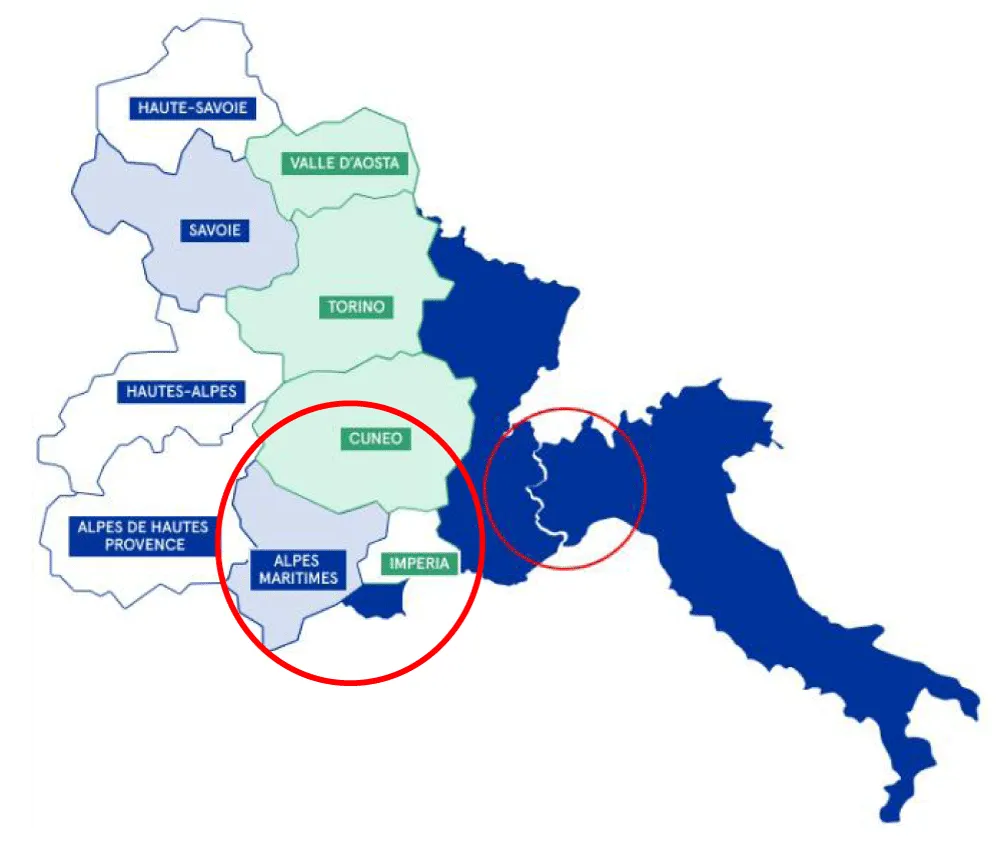
MSMEs are the main character of this project; their water needs are increasing significantly, especially in the food and agri‑food sector, even as the population grows and climate change intensifies water stress across the cross‑border area. To support this project there are also Aix-Marseille université, PoliTo; Chamber of Commerce in Cuneo, Turin and Nice; and Chamber of Trade and Craft in Provence -Alpes-Côte d’Azur.
Summer 2022, 2023 and 2024 showed a constant increasing of the temperatures, this phenomenon is a significant indicator for climate change, in particular in Europe and in the Mediterranean basin [15-18]. These summers were characterised by drought, successive waves of extreme heat, repeated wildfires—the effects of climate change are being felt, affecting daily life and agriculture activity. Therefore, there is a tense situation, oscillating between restrictions to protect the resource for everyone, territories declared in a state of emergency, rising prices, and poor resource management in certain activities. By 2050, surface water resources could decline by 30 to 40%. To reverse this trend, companies must take large‑scale and urgent measures to preserve, store, and use water more effectively. In addition, the hydrological anticipation and monitoring committee indicates that possible future prefectural orders could significantly restrict certain water‑intensive activities, which would in turn lead to business closures, job losses, and a severely weakened economic fabric. This additional risk, combined with the COVID pandemic, is undermining cross‑border businesses regardless of their needs. This shared problem is the real challenge of the project: the proper use of water in food production systems; supporting companies to make their water‑use and treatment processes more efficient, promoting more rational resource use, and embedding them in a framework of ecological transition and long‑term economic competitiveness. The overall objective of the project is to identify the administrative and technological barriers that currently prevent SMEs (both craft and commercial) from reducing their water consumption in their respective activities. Through project-specific support, we will aim to improve the efficiency of production practices and systems, using technological innovation and digital solutions to promote the sustainable use of water resources.
The first step was the selection of companies wishing to participate in the project’s activities, as well as implementing a technical assessment for companies with high water consumption, and finally, creating a technical task force that will support the project partners in order to observe, share, and strengthen the skills implemented within the GAG project.
A company to be defined as MSMEs must have no more than 10 employees, they can’t have any link with agriculture activity, only with industrial process.
Creation of a GAG pilot group: companies in the food sector wishing to implement a water consumption reduction approach and receive strong technical support. This pilot group is participating in training activities, visits to cross-border construction sites, working meetings, etc., stemming from the project’s work packages.
Creation of a technical and scientific committee with water operators mobilized for specific actions based on their expertise This technical committee is a valuable resource for the project; partners will be able to rely on this committee, but also anticipate needs and obstacles that could hinder project activities, and develop winning strategies for businesses and the project’s implementation.
These pilot projects will allow for the practical application of tools with constant data monitoring, in order to understand the progress made by the project.
Implementation at demonstration sites will prove the technical and economic feasibility of reusing wastewater or treated water and will encourage replication projects.
The monitoring activities will consist of setting up tracking tools (sensors, laboratory and data visualization equipment) and developing expertise to ensure food safety, data reliability, and the effective presentation of results.
This project includes the following actions:
Experimentation within pilot sites, of technical, technological, and behavioural practices for water conservation, water reuse/recycling in production, and water storage.
Launch of monitoring activities primarily using innovative technologies and activation of shared data reading and processing models for the pilot group of companies and directly linked to these construction sites.
Capitalizing on data collected on water consumption from the pilot group of companies before and after the project and the transferability of the systems implemented, particularly creating a maps of water consumption for these enterprises and a benchmark of companies offering a sustainable, efficient and cost-effective solutions.
The first step was to evaluating the presence of any leakages and suggestion about their reduction as a new and smart water meter, if it is necessary. During this evaluation, the industrial process will also be evaluated to determine the volume of water along the industrial process and if efficient and sustainable solutions can be applied. To support them we looked for companies which can suggest different type of solutions, like software and/or new technology to reduce the amount of water along the production activity and the clean-up of the area.
Next step is entrepreneurs’ formation such as: explanation of the Italian and French law about the use of wastewater and the cost of water; the concept of sustainability and climate change, a visit in a waste-water treatment facility and the last one is a technical workshop on cross-cutting technologies for water saving. Last step concerns the involvement of enterprises in a pilot test to show the results about the wastewater re-use, supporting the circular economy principle.
Creation of a GAG model assessment to define companies water needs and expenditures. This assessment is a valuable technical tool for identifying companies’ needs, consumption, and areas for improvement. It was conducted on-site and carried out by water experts. The company has access to the recommendations, data, and areas for improvement resulting from the assessment. An important part is to support this project with communication trough official and private social media (Facebook and Linkedin) but creating a website, too (https://www.interreg-alcotra.eu/fr/goutte-goutte-gag).
Our aim with this project is to establish a consortium of partners who will not only work together during the project, but also, and more importantly, continue to work together after its completion. Tools that we are committed to include the continuation and deployment of business diagnostics, hosting and maintaining the project’s observatory, monitoring water consumption data for businesses, and providing support.
Conclusion
The growing pressure on freshwater resources—driven by population growth, climate change and intensified droughts—makes efficient water management in the agro‑industrial sector urgent. The water footprint framework (blue, green, grey) helps quantify both direct and supply‑chain water use and pollution, enabling targeted interventions that are often more cost‑effective when applied upstream.
The main goal of this project is to support micro and small enterprises (MSMEs) in reducing their water foot print, reducing the volume of water during their own operations and reducing the discharge of wastewater and the creation of a GAG assessment to define companies’ water needs and expenditures.
The GAG initiative demonstrates a practical pathway: combine on‑site diagnostics, pilot demonstrations, sensor‑based monitoring and a technical support network to help MSMEs cut consumptive use, reuse treated water, and lower pollutant discharges. By focusing on supply‑chain hotspots, sharing data through common platforms, and building cross‑border technical capacity, small food businesses can both reduce risk from future water restrictions and improve long‑term competitiveness.
For policymakers and funders, the lesson is clear: support scalable diagnostics, incentivize supplier engagement, and remove administrative and technological barriers that prevent SMEs from adopting water‑saving solutions. For MSMEs, adopting the project’s pragmatic steps—measure, pilot, monitor, and replicate—turns water stewardship from a regulatory burden into an opportunity for resilience and cost savings.
In short, protecting freshwater in the ALCOTRA area and beyond requires coordinated action: rigorous measurement (water footprinting), targeted technical support (GAG assessments and pilots), and sustained collaboration between businesses, experts and institutions to make water use both sustainable and economically viable.
- Chapagain AK, Hoekstra AY, Savenije HHG, Gautam R. The water footprint of cotton consumption: an assessment of the impact of worldwide consumption of cotton products on the water resources in the cotton producing countries. Ecol Econ. 2006;60(1):186-203. Available from: https://www.sciencedirect.com/science/article/abs/pii/S0921800905005574
- Crovella T, Lagioia G, Paiano A. Agro-industrial water conservation by water footprint and Sustainable Development Goals. In: Current Directions in Water Scarcity Research. Vol. 8. Elsevier; 2024. p. 255-273.
- Hoekstra AY, Chapagain AK, Martinez-Aldaya M, Mekonnen MM. Water Footprint Manual: State of the Art 2009. Enschede: Water Footprint Network; 2009.
- Hoekstra AY, Chapagain AK. Globalization of Water: Sharing the Planet's Freshwater Resources. Oxford: Wiley-Blackwell; 2008/2011. Available from: https://www.researchgate.net/publication/270745057_Globalization_of_Water_Sharing_the_Planet%27s_Freshwater_Resources
- European Environment Agency. Water [Internet]. Copenhagen: European Environment Agency; 2023. Available from: European Environment Agency – Water
- FoodDrinkEurope. Data & Trends of the European Food and Drink Industry 2024 Edition [Internet]. Brussels: FoodDrinkEurope; 2024. Available from: FoodDrinkEurope – Data & Trends
- United Nations. Goal 6: Ensure availability and sustainable management of water and sanitation for all [Internet]. New York: United Nations; 2015. Available from: United Nations – Goal 6
- Hoekstra AY. The Water Footprint Assessment Manual: Setting the Global Standard. London: Earthscan; 2011. Available from: https://digitalcommons.unl.edu/cgi/viewcontent.cgi?article=1069&context=wffdocs
- Hoekstra AY. Green-blue water accounting in a soil water balance. Adv Water Resour. 2019;129:112-117. Available from: https://www.sciencedirect.com/science/article/pii/S0309170818311047
- Cao X, Bao Y, Li Y, Li J, Wu M. Unravelling the effects of crop blue, green and grey virtual water flows on regional agricultural water footprint and scarcity. Agric Water Manag. 2023;278:108165.
- Hendy CRC, Kleih U, Crawshaw R, Phillips M. Livestock and the Environment: Finding a Balance. Interactions Between Livestock Production Systems and the Environment, Impact Domain: Concentrate Feed Demand. Rome: FAO; 1995.
- Mekonnen MM, Hoekstra AY. A global assessment of the water footprint of farm animal products. Ecosystems. 2012;15(3):401-415.
- Falkenmark M. Freshwater as shared between society and ecosystems: from divided approaches to integrated challenges. Philos Trans R Soc Lond B Biol Sci. 2003;358(1440):2037-2049.
- Falkenmark M, Rockström J. Balancing Water for Humans and Nature: The New Approach in Ecohydrology. London: Earthscan; 2004.
- Faranda D, Pascale S, Bulut B. Persistent anticyclonic conditions and climate change exacerbated the exceptional 2022 European-Mediterranean drought. Environ Res Lett. 2023;18(3):034030. Available from: https://iopscience.iop.org/article/10.1088/1748-9326/acbc37
- Hisdal H, Stahl K, Tallaksen LM, Demuth S. Have streamflow droughts in Europe become more severe or frequent? Int J Climatol. 2001;21(3):317-333. Available from: https://rmets.onlinelibrary.wiley.com/doi/abs/10.1002/joc.619
- Peña-Angulo D, Vicente-Serrano SM, Domínguez-Castro F, Murphy C, Reig F, Tramblay Y, et al. Long-term precipitation in Southwestern Europe reveals no clear trend attributable to anthropogenic forcing. Environ Res Lett. 2020;15(9):094070. Available from: https://iopscience.iop.org/article/10.1088/1748-9326/ab9c4f
- Hoekstra AY. Virtual water trade: a quantification of virtual water flows between nations in relation to international crop trade. In: Hoekstra AY, editor. Virtual Water Trade: Proceedings of the International Expert Meeting on Virtual Water Trade. Delft: UNESCO-IHE; 2003. p. 25-47.

 Save to Mendeley
Article Alerts
Subscribe to our articles alerts and stay tuned.
 This work is licensed under a Creative Commons Attribution 4.0 International License.