Activity of Turkey’s Internet Community before the Istanbul Earthquake
1Department of Heliogeophysics, Institute of Applied Geophysics, Moscow, Russia
2Department of Physics, Voronezh State University, Voronezh, Russia
Author and article information
Cite this as
Tertyshnikov AV, et al. Activity of Turkey’s Internet Community before the Istanbul Earthquake. Glob J Ecol. 2026; 11(1): 1-4. Available from: 10.17352/gje.000115
Copyright License
© 2026 Tertyshnikov AV, et al. This is an open-access article distributed under the terms of the Creative Commons Attribution License, which permits unrestricted use, distribution, and reproduction in any medium, provided the original author and source are credited.The activity of the Istanbul internet population before a nearby earthquake with a magnitude of 6.3 on 23 April 2025 was evaluated using search-engine queries for the term “su” (Turkish “water”). This term has previously demonstrated informative behavior in diagnosing seismic hazard in different regions. The morphology of amplitude diagrams for the dynamics of the term’s popularity was analyzed. The informational precursor was expressed through dominant periods of 3, 4, 6, and multiple periods of 12 days. These features indicate the presence of a sensory-information response in the behavior of internet users during seismic hazards.
Research on the activity of the internet community before earthquakes during periods of seismic hazard can be viewed from the perspective of "Sensory Ecology," which investigates the neurobiological mechanisms of sensory systems and behavioral processes used to obtain sensory information, as well as their role in larger evolutionary processes. "Ecology," in contrast, analyzes the exchange of matter and energy.
Sensory interactions make it possible to record the influence of changes in geophysical fields on the behavior and functions of certain physiological systems (sense organs) of organisms that receive, process information from the environment, and respond to its changes, exchanging energy and sensory information. Furthermore, through human visual perception, it is possible to assess ecological and sensory signals from various populations, which opens up new possibilities for ecological monitoring. Sensory information complements primarily visual human perception with the analysis of the behavior of other species of organisms that rely more heavily on other senses. The presence of a second signal system in humans allows for the recording of these processes and phenomena. This requires technologies for the automated collection and analysis of sensory information.
To assess the prospects of sensory monitoring, preliminary experiments were conducted in various regions of the world to diagnose the reaction of the Internet community to sensory processes. In [1], nearly 30 strong earthquakes and Internet search engines were used. In [2,3] analyzed the activity of the internet population before strong earthquakes in Mexico, Japan, and Afghanistan, the activity of the Internet population before strong earthquakes in Mexico, Japan, and Afghanistan was analyzed. The regions analyzed are characterized by different religious mentalities and attitudes toward natural hazards.
During the experiments, a list of terms was compiled that Internet users actively searched for in Internet search engines. This list constitutes a working ontological model of the diagnosed process or phenomenon. The regional nature of this model is quite evident [1].
The term “water” ranked highest on the list (up to 80% of the cases considered).
A distinctive feature of the selection of concise terms for the seismic hazard model is the style of everyday communication. For example, “hydrogeological precursors” will be indirectly manifested in the key term “water.”
With the development of computer technology, search engines, and artificial intelligence [2], a single personal computer proved sufficient for diagnosing sensory interactions in real time. The proven technology was also tested during the Istanbul earthquake of 23 April 2025, which, according to the Federal Research Center "Unified Geophysical Service of the Russian Academy of Sciences," occurred at 09:49:10 (GMT) in the Sea of Marmara, several tens of kilometers from Istanbul, with a magnitude of M = 6.3 [4]. The coordinates of the epicenter were latitude φ = 40.92°, longitude λ = 28.24° (Figure 1), with a hypocentral depth of about 10 km.
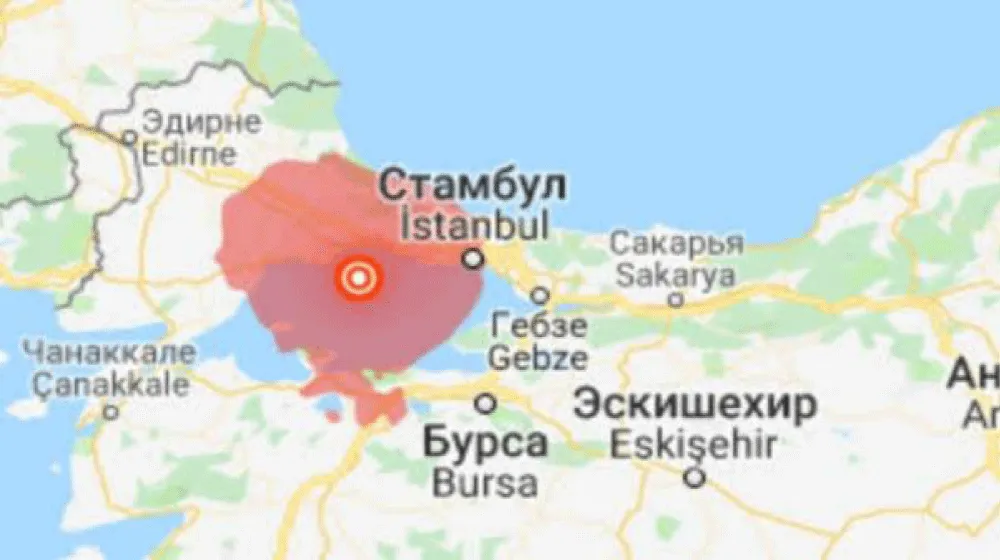
The precursors of this earthquake were felt even in Anapa, Russia, in variations in the flow of low-energy neutrons, and the consequences were felt in Ankara.
Model of society's response to seismic threat
Society, an element of the anthropogenic environment of the natural world, is an indicator of changes in geophysical fields when searching for responses to sensory interactions [5]. Environmental monitoring is carried out by society at conscious and unconscious levels and is manifested in the intensity of communication, including by the population of internet users. By population, in this case, we mean the regional part of society [6].
The behavior of members of the internet population manifests as a search for confirmation of their observations, sensations, descriptions, and discussions through electronic messages and texts of the behavior of other populations of organisms. Such activity in the form of psychomotor acts (actions) is aimed at communication, searching for the satisfaction of needs (drives, motives, intentions, etc.).
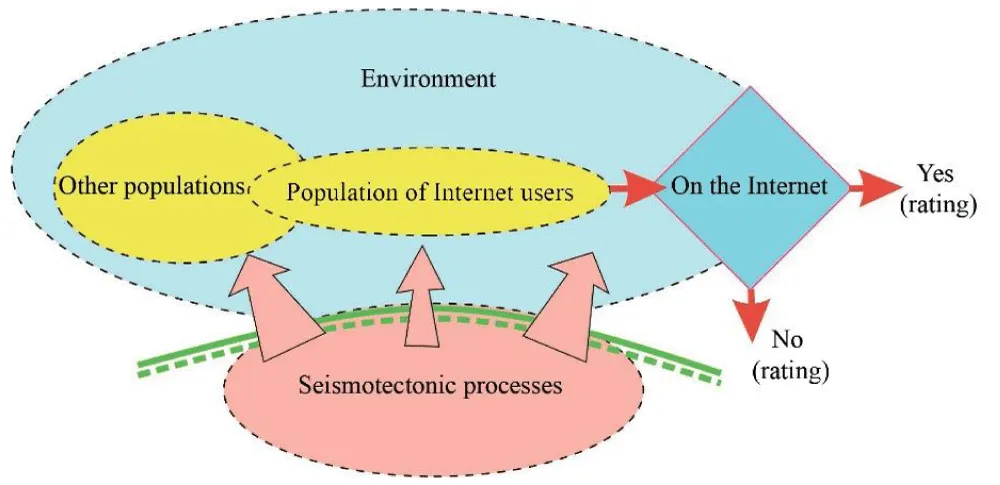
Figure 2 presents a conceptual diagram of the response of the internet population to disturbances in geophysical fields during seismic hazard.
Internet search engines [7] are not only a tool for searching for information for members of society, but also for analyzing their activity. Changes in the flow of events by topic, characterized by common keywords related to the behavior of populations of organisms, can be recorded using tools provided by search engine providers (e.g., Yandex™, Google™, Bing™, etc.), content aggregators (e.g., Digg™, Reddit™), content recommendation systems (e.g., StumbleUpon™, Pinterest™), etc. They often combine several functions. For example, large social networks such as Facebook™ and Twitter™ store billions of user messages and provide the ability to post new ones.
The capabilities of Internet search engines (machines) are actively used in various fields of activity based on queries from the search robot database, data from the search log, and the browser log. Data from the search log represents the search activity of search engine server users based on the content of the search query. Data from the browser log is the browser activity of browser application users based on the content of the search query.
Statistical web data is obtained from the search engine database, which represents embedded objects or links to content elements contained on web resources based on the content of the search query [7] provides a fairly detailed description of the features of search engines, including Google. Based on data from the search log, browser log, or statistical web data, it is possible to predict the popularity of the query being analyzed. The self-organization of the Internet community amplifies the emergence of weak signals-sensations from individual users, increasing their number and repetition of the discussed words and terms. Based on the intensity of the flow of requested words and terms from the list defining the ontological model of seismic hazard of the diagnosed process, it is possible to identify abnormal activity among the Internet user population in the event of a threat of a strong earthquake.
A feature of selecting brief terms for the model of seismic hazard is the style of everyday communication. For example, "hydrogeological precursors" will be indirectly manifested in the key term "water." A set of such terms constitutes the working ontological model of the diagnosed process or phenomenon. The regional nature of the manifestation of this model is quite obvious [1].
The change in the flow of the requested keyword in the diamond in Figure 2 can be represented by the simplest simulation model of a "box" according to the National standard R ISO/IEC 12207-99 with input and output information and control actions.
Materials and methods
To demonstrate the technical solution for the results, the term “water” (Turkish: “su”) was used to assess the activity of Istanbul's large Internet population before a selected strong earthquake. In 80% of cases in English transcription, regional Internet populations in other regions of the Earth responded to seismic hazards in other regions of the Earth using this term. The dynamics of the term “su” were studied using a search engine [8].
The use of the national term for the earthquake under study on 23.04.2025 will make it possible to limit the errors of geographical reference of the information precursor (Figure 3). At the same time, it is possible to evaluate other terms for the national ontological model of seismic hazard in the region under consideration.
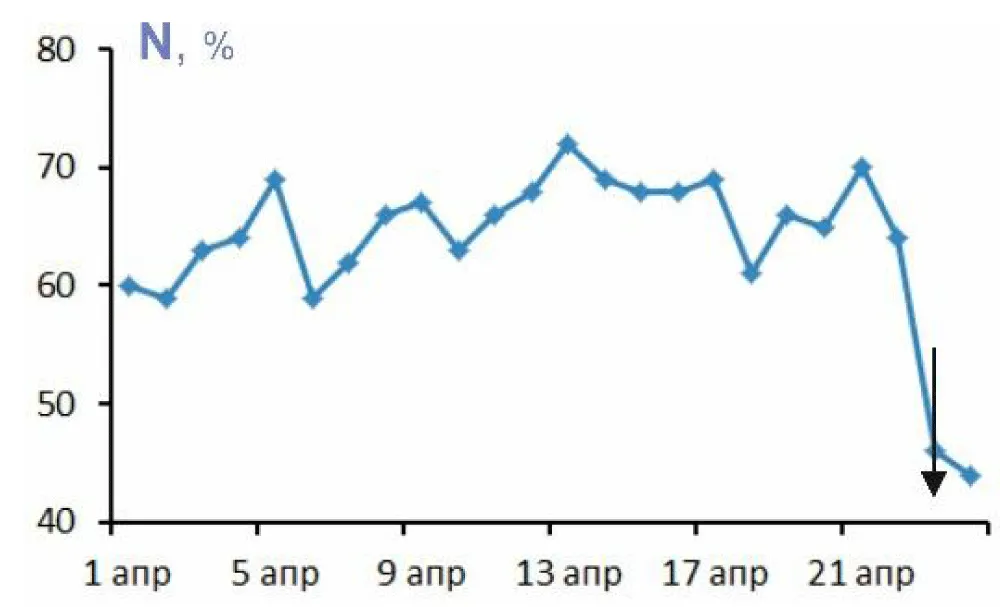
Before the earthquake, the number of queries for the term “su” decreased abnormally. For the predictive function of seismic hazard monitoring, it is interesting to study the variations in the estimates obtained before the earthquake.
The presumed small signals of internet population activation within the natural noise in Figure 3 are best diagnosed using Fourier analysis. The normalized amplitude diagrams of the time series in Figure 3 over a sliding window with a width of 32 days are presented in Figure 4.
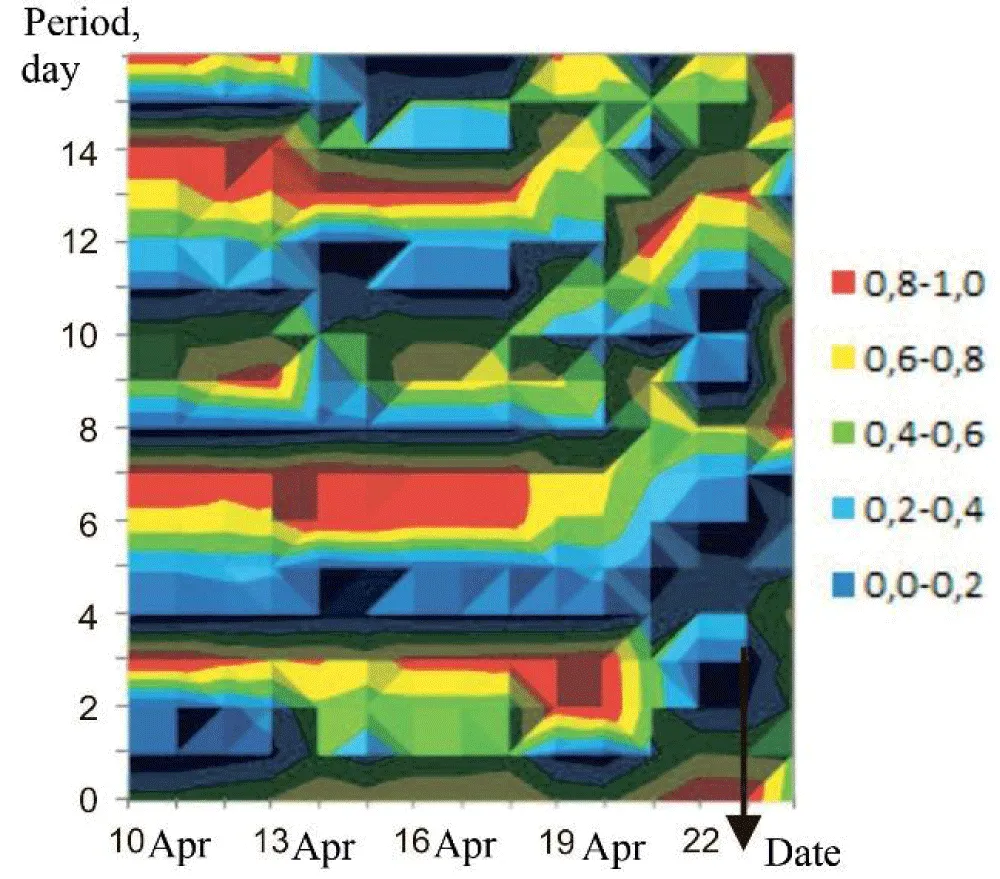
Amplitude diagrams were calculated using the fast Fourier transform and assigned to the right boundary of the sliding window. In each period, the amplitude estimates calculated in the interval from 10.04.2025 to 24.04.2025 were normalized by their min-max.
The traditional method of analyzing anomalies in minimax values in parametric statistics is to evaluate statistical indicators (e.g., confidence intervals or p-values). However, in this case, since we are considering a single earthquake, a “traffic light” indicator is used to illustrate the behavior of the Istanbul Internet population. Five gradations are used to represent the amplitude intensity in Figure 4. The red, yellow, and blue colors of the amplitudes are considered in relation to the activity of the Internet population during seismic hazards. The blue amplitude range allows us to compare the imbalance with dangerous amplitude levels. At the same time, morphological changes in spectrograms are clearly visible.
Results & discussion
Anomalous changes in the activity behavior of the Istanbul internet population were detected as early as January 2025 during the diagnosis of the morphology of information precursors of macroseismicity near Santorini Island [9]. But at that time, Istanbul had reduced activity compared to other Turkish "correspondent" cities. After the main earthquake near Santorini Island, the activity of the Istanbul internet population increased.
In the morphology of Figure 4, before the earthquake, the dominant periods of 3 and 6-7 days stand out, as before earthquakes in other regions. For example, for the Japanese earthquake on 5.11.2018 and the eruption of the Sakurajima volcano on the Japanese island of Kyushu on 14.11.2018 [2]. Two to four days before the event, with a general trend of increasing amplitudes at higher frequencies in Figure 4, the 2-day period became active. But the earthquake occurred against the background of reduced amplitudes in almost all periods.
Regarding the possible influence of heliogeophysical factors on the development of the seismic process, a weak connection between magnetic and seismic activity can be noted [1,5], as well as with the trend of the studied term. An increased K-index was recorded on April 16 (K = 5+) and April 21 (K = 4+). Solar flares of class M were recorded on April 19, 21, and 22. The third quarter of the Moon was on April 20-21.
The presence of deformations of the earth's crust before the considered earthquake was confirmed by data on the power of the flow of low-energy (thermal, with energy 0.02 – 0.5 eV) neutrons in Anapa. The measurements were carried out at the "Ustinya" installation with a frequency of 3 minutes. The precursor of the Istanbul earthquake in Anapa was manifested in the variations of the three-hour coefficient of excess of the thermal neutron flow; Figure 5 shows the range of variations of the estimates of the three-hour coefficient of excess during the day [10].
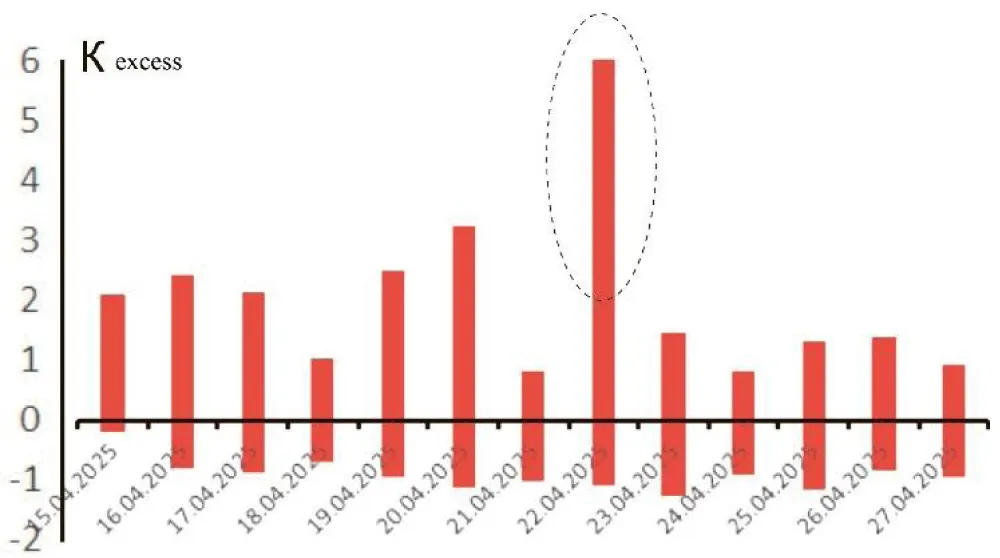
The coefficient of excess was calculated in a sliding three-hour window. The obtained estimates were assigned to the right boundary of the window. The oval in Figure 5 highlights a potential precursor of the Istanbul earthquake, associated with the passage of a deformation wave in the Earth's crust and the third quarter of the Moon. A sharp outlier on the eve of the earthquake corresponds to the ordering of the variations in the thermal neutron flow and the manifestation of the information precursor in Figure 4.
Conclusion
Increased activity of the Istanbul internet population, measured by the number of queries for the term "su" (Turkish "water"), preceded the strong nearby earthquake and corresponded to the evolution of the seismic hazard.
The "signal" periods in the morphology of the calculated amplitude diagrams of the Istanbul internet population's behavior were periods of 2-3, 6-7, and 12 days.
The choice of the term "su" for the ontological model of seismic hazard and the diagnosis of sensory interactions of the internet society was confirmed.
- Tertyshnikov AV. The internet-community response to the Mexican earthquake of February 1, 2019. E3S Web Conf. 2020;196:03007. Available from: https://doi.org/10.1051/e3sconf/202019603007
- Tertyshnikov AV. The Sakurajima eruption of 14 November 2018, based on the semantic criteria of seismic hazard on the internet. Heliogeophysical Research. 2022;35:12–20. Russian.
- Tertyshnikov AV. The reaction of internet users to seismic hazard. World J Environ Biosci. 2023;12(4):14–17. Available from: https://doi.org/10.51847/VzkUqyDLWc
- Unified Geophysical Service of the Russian Academy of Sciences. Information on seismic events. 2025. Available from: http://gsras.ru
- Tertyshnikov AV. Website visitation of the Institute of Applied Geophysics and magnetic activity in 2018. Heliogeophysical Research. 2019;21:12–17. Russian.
- Tertyshnikov AV. Internet screening of seismic hazard indicators. In: Problems of military-applied geophysics and environmental monitoring. Proceedings of the VII All-Russian Scientific Conference; Saint Petersburg. 2022;133–139. Russian.
- Yudin A. Global search engine statistics. 2018. Available from: https://marketer.ua/ru/search-engine-stat-2018/
- Google Trends. Search trends for “Νερό” in Greece. Available from: https://trends.google.com/trends/explore?date=today%201-m&geo=GR&q=%CE%9D%CE%B5%CF%81%CF%8C&hl=ru/
- Tertyshnikov AV, Obelchenko DS. Trend of the informational precursor of macroseismicity near Santorini Island in early 2025 using AI resources. In: Actual problems of physics and technology. Proceedings of the International Scientific and Practical Conference; Dushanbe: Donish Publishing House; 2025;60–65.
- Tertyshnikov AV. Assessment of the prospects of earthquake precursors. Heliogeophysical Research. 2019;22:12–17. Russian.



 Save to Mendeley
Article Alerts
Subscribe to our articles alerts and stay tuned.
 This work is licensed under a Creative Commons Attribution 4.0 International License.