Open Journal of Environmental Biology
Experimentation on the Coastal Marine Habitat Restoration through Ecological Engineering: Creation and Test of Coastal Nurseries in the Mediterranean
1UMR CNRS 6134 Sciences for Environment, University of Corsica, Corte, France
2Creocean Environment and Oceanology, Keran Group, Montpellier, France
3Chorus Acoustics, Chorus Research Institute, Grenoble, France
4UAR CNRS 33514 Stella Mare, University of Corsica, Biguglia, France
Author and article information
Cite this as
Agostini S, Thorin S, Gervaise C, Vela A, Lossent J, Laure-Hélène G. Experimentation on the Coastal Marine Habitat Restoration through Ecological Engineering: Creation and Test of Coastal Nurseries in the Mediterranean. Open J Environ Biol. 2025; 10(1): 44-52. Available from: 10.17352/ojeb.000050
Copyright License
© 2025 Agostini S, et al. This is an open-access article distributed under the terms of the Creative Commons Attribution License, which permits unrestricted use, distribution, and reproduction in any medium, provided the original author and source are credited.The degradation of coastal marine habitats and biodiversity loss pose significant ecological challenges, requiring restoration efforts. In June 2024, the European regulation on nature restoration established a framework for managing and restoring these ecosystems. To address the scale of this task and limited experimental resources, the CREANURS program, led by the University of Corsica, was launched to test micro-habitat prototypes targeting key marine species. The project aims to enhance scientific and technical knowledge to optimize the restoration of small coastal habitats in the Mediterranean. Six types of micro-habitat prototypes were designed and tested in situ at the port of Porticciolo (Haute-Corse, France). Monitoring included structural changes, colonization by fauna and flora, and acoustic characterization. Results showed most prototypes lacked sufficient physical resistance to exceptional storms, limiting monitoring duration. Biological colonization results were mixed; most micro-habitats were less effective than natural environments for mobile fauna. However, the FracFoam prototype showed promise as a shelter for a diverse detritivorous benthic community, similar to that associated with Posidonia litter. Acoustic monitoring revealed a rich benthic biophony, ranking the site among the most efficient in the French western Mediterranean. Despite heterogeneous results and environmental constraints, FracFoam stands out with an estimated 80% efficiency for restoring degraded benthic habitats, offering new perspectives for facilitating natural Posidonia colonization.
MH: Micro-Habitat; MHs: Micro-Habitats
Introduction
Benthic marine habitats, characterized by a diversity of substrates, environmental conditions, and engineered species, fulfill vital ecological functions such as nursery grounds, spawning grounds, feeding grounds, and protection [1-3]. These environments harbor rich biodiversity and provide essential ecosystem services [4,5]. However, they are subject to increasing anthropogenic pressures, particularly in coastal areas, including pollution, unsustainable recreational uses, artificialization, and fishing [6]. These degradations can exceed the natural recovery capacity of ecosystems, making a return to a previous state impossible [7-11]. The 2020 European assessment indicates that 81% of European habitats are in poor condition, despite existing protection policies [12]. This situation underscores the need for additional measures, leading to growing interest in the ecological restoration of marine ecosystems [13]. Restoring ecological functions is identified as one of the greatest challenges in marine ecology. In response, the United Nations Decade on Ecosystem Restoration (2021-2030) calls for the revitalization of ecosystems globally [14].
It is in this context that the CREANURS program, led by the University of Corsica, and financed by the Water Agency (a French public institution), is being implemented. The objective is to develop and experimentally test small-scale artificial habitats, called "microhabitats," specifically designed for the restoration of degraded or destroyed benthic coastal habitats. These microhabitats aim to function as "nurseries" for the young stages of marine organisms, "spawning grounds" for breeders, or "specific" habitats to test attractiveness and direct natural recruitment toward species of economic or heritage interest. The project thus seeks to replace or complement degraded natural habitats to increase or maintain local marine biodiversity and fish populations. The experiment specifically targeted Posidonia, an emblematic Mediterranean species.
Materials and methods
The CREANURS program consisted of the design of six different types of artificial microhabitats, and the fabrication, immersion, and in situ experimental testing of 56 modules. The target organisms for these experiments were echinoderms (Paracentrotus lividus), cephalopods (Octopus vulgaris, Sepia sp.), post-larvae and juvenile fish, and invertebrates in general.
The prototype design, carried out in collaboration with two innovative French companies SM2 Solutions Marines and Architeuthis, took into account the site's environmental constraints, the intended function (nursery, spawning ground), and the target species. Various materials, including recycled and plant-based materials, were used and tested for their attractiveness. The six concepts developed were:
- Local macroalgae wall (Nursery for juvenile fish/invertebrates, on dock/rockfill).
- FracFoam (Nursery for juvenile fish/invertebrates, on sand).
- Sea urchin microhabitat (Nursery for juvenile sea urchins, on sand).
- Cephalopod microhabitat (Spawning ground/Nursery for cephalopod spawners, on sand).
- Artificial seagrass bed (Spawning ground/Nursery for fish/invertebrates, on sand).
- Totem (Nursery for juvenile fish/invertebrates, on rock dike).
The site chosen for the experiment is the port of Porticciolo (Cap Corse, France), selected for the quality of its environment, its ease of access, its monitoring potential, and its educational showcase (Figure 1). An experimental area was set up in situ to test the attractiveness of micro-habitats by natural capture. The modules were positioned in quayside, seawall rockfill, and natural sandy areas, depending on the environmental parameters and the target species. An initial installation of the modules took place in April 2017, followed by a partial or total reinstallation in June 2018 following damage caused by storms. An initial state of the site was carried out by the Creocean company in April 2017 to serve as a reference [15]. The installation of the modules, with a limited footprint (footprint less than 10 m2, weight less than 80 kg, volume less than 2 m3, height less than 1.5 m) and a lifespan calibrated for the experiment (1 year of immersion), was carried out by the design companies and the Stella Mare team, with fixings adapted to the substrate (harmony screws on sand, drilling then resin on dike and rockfill).
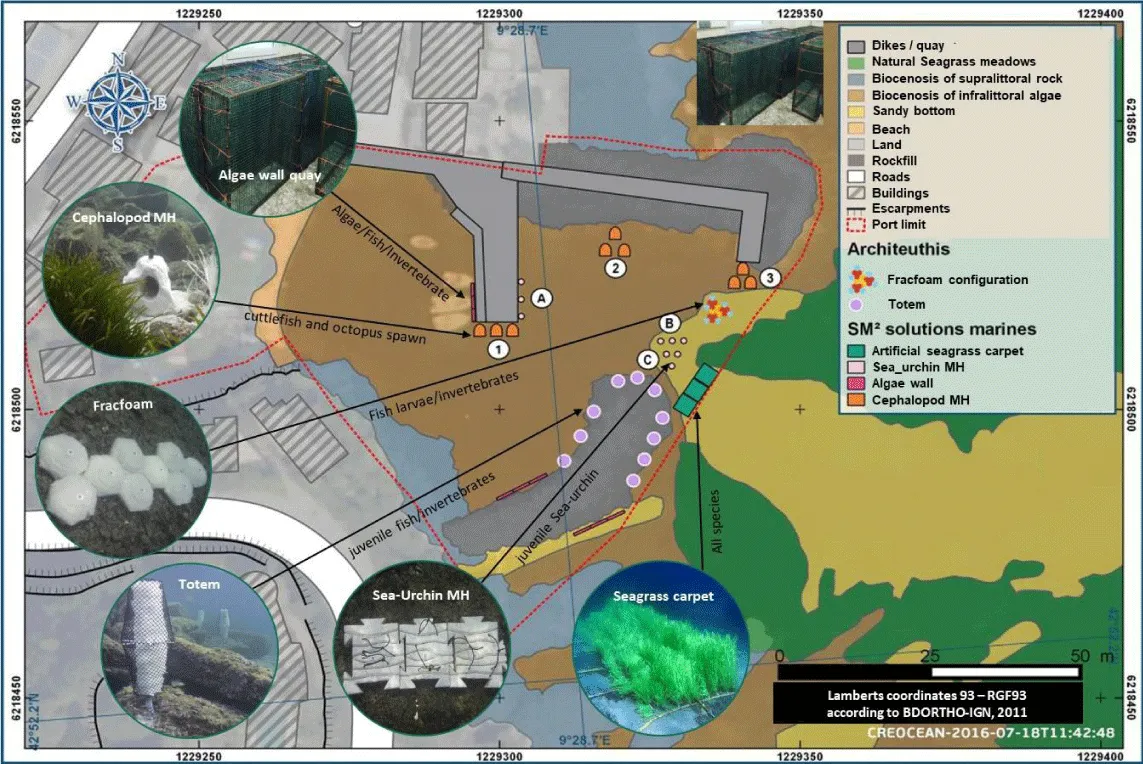
The scientific monitoring was planned over approximately 12 months, although it was heterogeneous due to the necessary reinstallations. The monitoring protocol was defined in collaboration with the companies Creocean, Chorus, SM2 Solutions, Architeuthis, and engineers from the Stella Mare platform at the University of Corsica [15]. It included:
- Monitoring of structural changes (deterioration, clogging, fixations) by the Stella Mare team.
- Monitoring of the fixed flora and fauna colonization (permanent quadrats, photographs, species counts) by Creocean.
- Behavioral monitoring of mobile fauna (fish, crustaceans, echinoderms, mollusks), primarily post-larval/juvenile and reproductive fish populations, by the Stella Mare team. This monitoring, based on the visual census method [16], involved visual counts by diving into the targeted modules and reference sites, with species identification enumeration and size estimation. Fish monitoring was carried out monthly, or even bimonthly in spring/summer.
- Acoustic monitoring using passive acoustics in partnership with the Chorus Institute. Hydrophones were positioned inside (P1, P2, P3) and outside the port (P4, P5, natural habitats) to characterize the acoustic environment and extract the biophony of benthic invertebrates and fish [17,18]. Measurement sessions were carried out in April and October 2017 [15]. The acoustic monitoring employed passive acoustic methods to evaluate the biodiversity of marine environments, utilizing biophony as a proxy for the state of animal communities. Data were collected using RTSYS SDA 14 recorders and HTI 92 hydrophones, deployed as single units and as compact four-hydrophone arrays to enable sound source localization. The processing of biological acoustic data for both benthic invertebrates and fish involved specific algorithms tailored to their distinct sound characteristics. For benthic biophony, which consists of short, strong impulses generating wide-band spectra above 1.5 kHz, an optimal detector was used, combining a high-pass filter with an energy detector that compares signal energy against the estimated noise floor. This methodology, including the detailed algorithms for the detection and description of benthic biophony, is thoroughly described in a scientific article [18]. In contrast, ichthyological biophony, characterized by successions of rapid impulses predominantly in the 50 Hz to 1500 Hz range, required a different approach to mitigate masking by boat noise. Instead of detecting individual impulses, the methodology focused on identifying 'impulse trains' exhibiting a repetition rhythm, adapted from cetacean click train detectors. Furthermore, the use of compact four-hydrophone arrays allowed for the localization and mapping of detected biological sounds in 3D (azimuth and elevation), which is crucial for distinguishing sound production originating from artificial nurseries versus adjacent natural habitats given their acoustic proximity.
About trophic functioning, we assigned a trophic code to each species according to the Word 1990 method, which is based on three criteria: the type of nutrient material collected (size, nature); the compartment in which this material is collected (water column, surface or sub-surface of the sediment); the capture method used to collect the material (passive or active capture from appendages, capture by pumping and filtering, capture by searching the substrate, habitat use). Based on these three criteria, different groups and trophic codes are established:
- Group 1: Suspension feeders microphagous detritivores that feed on very small particles suspended in the water column and are generally abundant in healthy, well-ventilated environments;
- Group 2: Surface microphagous detritivores that feed on very large particles but are deposited on the bottom or integrated into surface sediments;
- Group 3: Deposit feeders (macrophages) that feed on larger particles deposited on the bottom or incorporated into the sediment; this group includes most carnivores;
- Group 4: Species characteristic of highly degraded anaerobic environments.
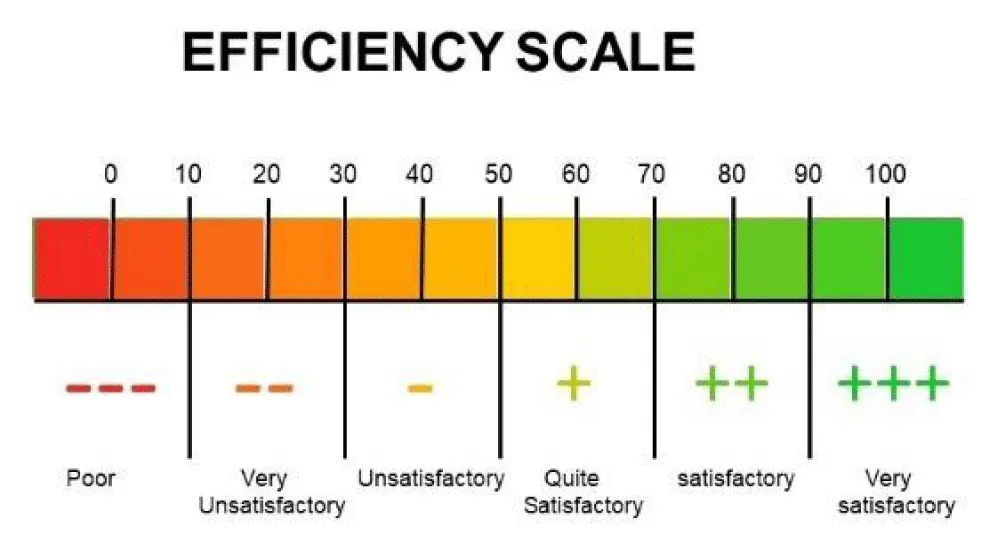
The effectiveness of the tested prototypes is evaluated according to 4 main criteria: (i) their physical resistance (structure and fixation), (ii) their implantation site (biological interest and environmental constraints), (iii) their colonization and contribution of biological biomass (animal and plant) compared to the natural reference zones and (iv) the species of interest recruited according to the targeted species and ecosystem services provided. Depending on the results obtained for each of the characteristics composing our criteria taken into account above, relative effectiveness for each of our prototypes was estimated according to an effectiveness scale divided into 6 classes: 0% - 10% Poor, 10% - 30% Very Unsatisfactory, 30% - 50% Unsatisfactory, 50% - 70% Fairly Satisfactory, 70% - 90% Satisfactory, above 90% Very Satisfactory.
Results
Micro-habitat structure
Most prototypes showed insufficient resistance to the strong hydrodynamic conditions and exceptional storms that occurred in 2017 (Ana and Bruno in December) and 2018 (Carmen and Eleanor in January, Adrian in October, and Flora in December), particularly in the shallow and exposed port of Porticciolo. The major weak points were the fastening systems. The most affected prototypes were the Totems and Cephalopod Micro-habitats, which were quickly torn off or destroyed. The Seaweed Walls also suffered significant structural damage. The FracFoams were severely affected by the storms, with some modules displaced or destroyed, but maintained relative integrity compared to the others. The Sea Urchin Micro-habitats and the Artificial Seagrass Bed withstood the storms better, especially the Artificial Seagrass Bed positioned deeper outside the port, although it showed signs of progressive deterioration of its fronds. The damage led to the interruption of biological monitoring from December 2017 and November 2018, and the need for a second installation in June 2018.
Colonization of fixed flora and fauna
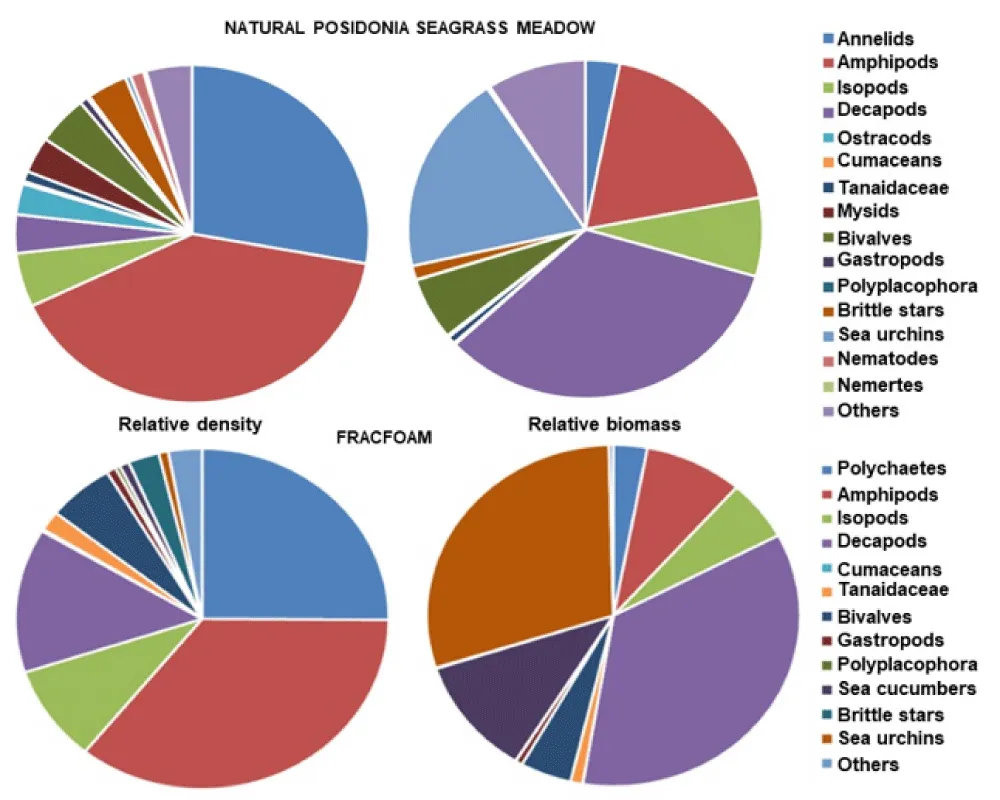
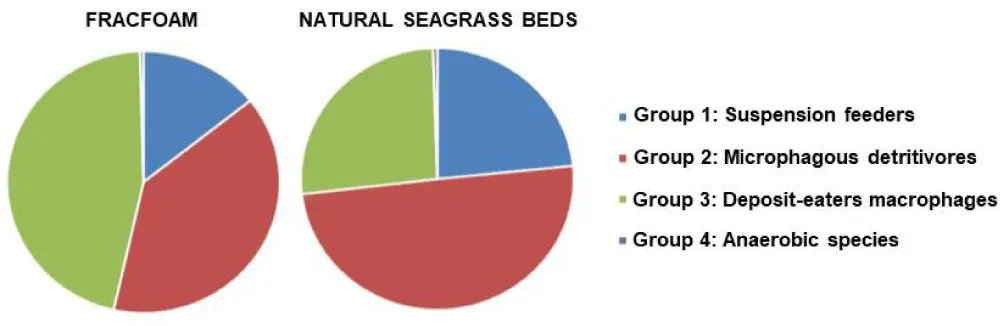
Overall results are mixed. The Seaweed Walls did not show conclusive results, as the algae did not maintain themselves sustainably. The Artificial Seagrass achieved epiphytic colonization comparable to the natural seagrass on its fronds, but the benthic community colonizing the artificial mat was very different and had low abundances and biomasses. The Sea Urchin Microhabitats were ineffective at attracting juvenile sea urchins and limited for colonization by hard substrate species, being easily covered by sediment. The Cephalopod Microhabitats were mainly colonized by common algae and did not attract any spawning or adult octopus. The FracFoam prototype showed little interest in external epiphytic flora and fauna, but the interior of the modules was colonized by abundant and diverse benthic fauna (small crustaceans, annelids, juvenile sea urchins, sea cucumbers), attracted by trapped plant debris. This benthic community is similar to that of natural Posidonia litter and mattes (Figure 2). Composed of small detritivores dominated by amphipods, isopods, and polychaetes, it is very similar to the communities living on mattes and in Posidonia litter. Among the 79 species recorded in the FracFoam and the 97 species recorded in the natural herbarium in 2018, 40 species are common to both lists. There is a strong similarity between the two data sets for the results of species richness, total abundance, and Shannon index (Table 1). The biomass also differs little between the two data sets. Furthermore, the results on the distribution of densities by taxonomic group are very similar; the results are very similar to those found in the FracFoam (Figure 3). FracFoam is home to more deposit-feeding species (Group 3) while the natural seagrass bed is dominated by detritivorous species (Group 2). Both habitats have virtually no Group 4 species, which indicates very deteriorated conditions in terms of eutrophication.
Behavioral monitoring of mobile fauna
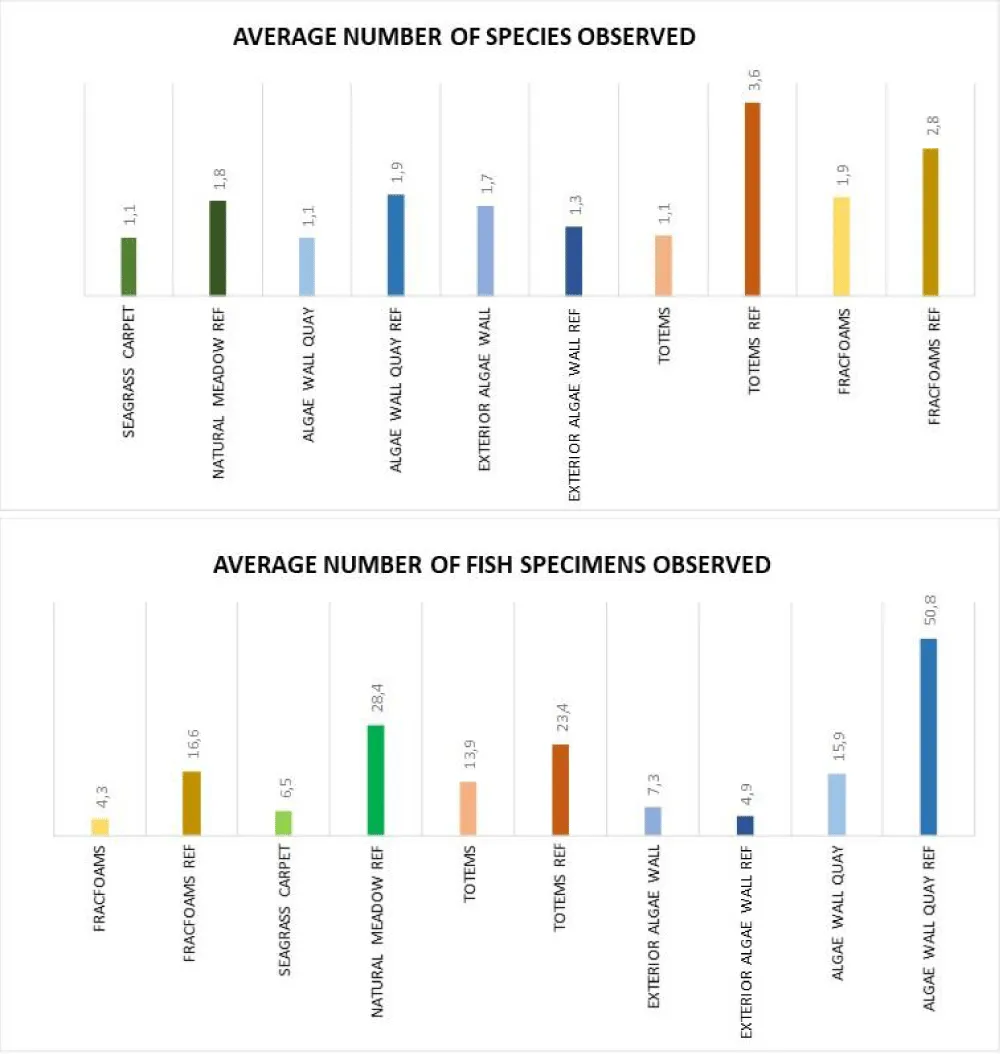
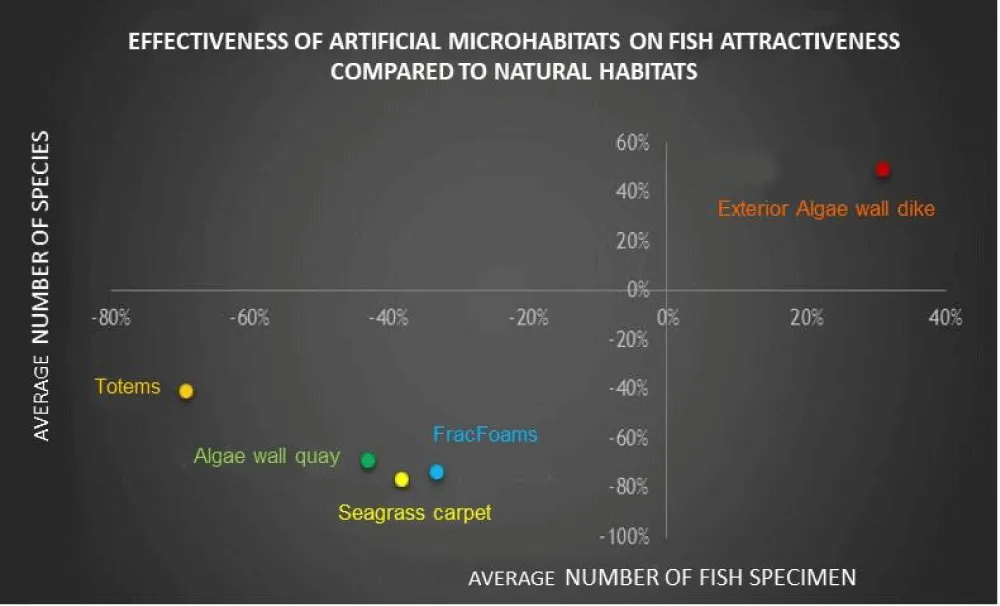
The behavioral monitoring of mobile fauna, mainly fish, was made very heterogeneous by the successive degradations of the structures due to bad weather conditions and exceptional storms that occurred during the project period, thus limiting the effective duration of monitoring from 4 to 19 months depending on the prototype. These observations focused mainly on the summer period, with some sessions in late spring or early autumn. Overall, the results showed that no artificial micro-habitat proved more effective than the surrounding natural environment in attracting and maintaining mobile fauna in terms of species diversity and fish abundance. The natural reference areas generally presented higher species diversity and number of individuals, with typically 1 to 4 species and 14 to 51 individuals observed per dive on the natural sites, compared to 1 to 2 species and 4 to 16 individuals on the artificial habitats (Figure 4). The only prototype that potentially showed results superior to those of its reference was the "Seaweed Wall" positioned on the outer dike (Figure 5). This module presented a greater diversity and an overall higher number of individuals compared to its reference area, with an average of 1.7 species versus 1.3 and 7.3 individuals versus 4.95. However, this observation is based on a very short monitoring time of only 4 months before the destruction of the module, which prevents definitive conclusions from being drawn on its effectiveness. For species of interest to commercial fishing, such as Diplodus sp. and Pagelus acarne, the natural reference areas proved more attractive than the artificial habitats tested. Among the artificial habitats, the "Artificial Seagrass Carpet" presented the values closest to those of its natural reference site for these species. It is also noted that the visual census monitoring method using scuba equipment may have limitations due to its punctual and potentially disruptive nature to the environment.
Acoustic monitoring
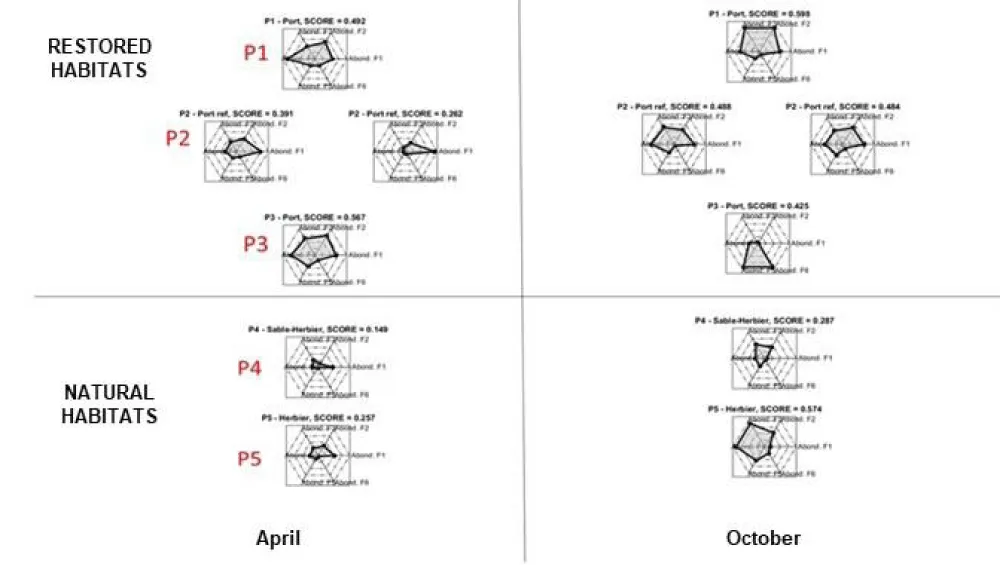
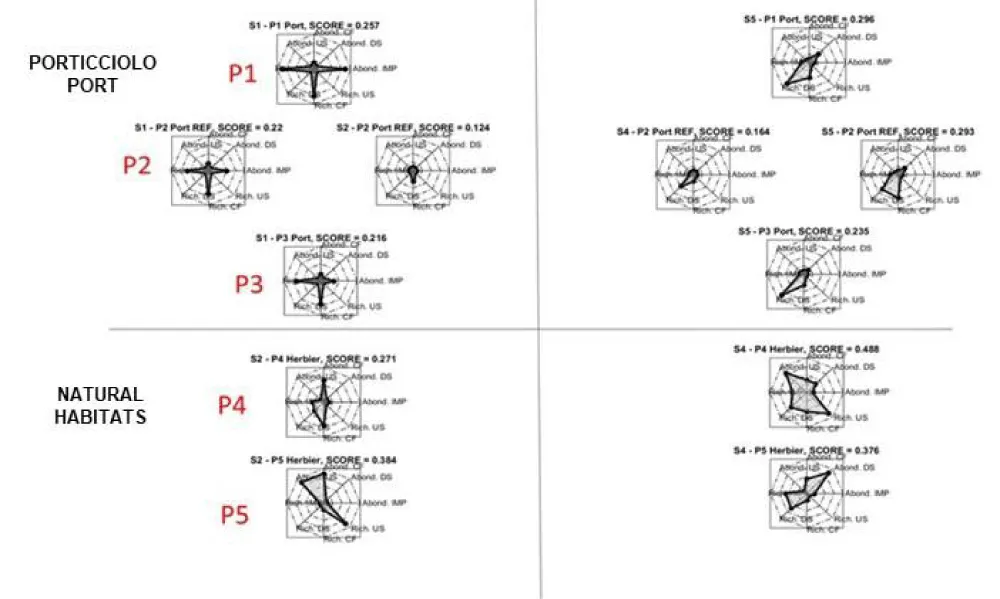
Carried out in April and October 2017, they showed abundant biophony (benthic and ichthyological) at all measurement points (Figures 6,7). Benthic biophony is particularly abundant inside the port of Porticciolo, where the artificial structures are installed. This abundance ranks the CREANURS site among the richest sites in benthic biophony in the French western Mediterranean, compared to data from the CALME network [19] and other restoration projects (Tables 2,3). Ichthyological biophony is also abundant and rich, dominated by the "kwa" sound emitted by the scorpion fish. The CREANURS site is in the same range of otoacoustic scores as other ecological restoration sites studied by Chorus in terms of ichthyological biophony. The acoustic analysis also revealed significant anthropophony due to boat passages. The data suggest the existence of different fish communities between the port and the seagrass bed, evolving with the season, but the monitoring period (two seasons) was too short for statistically significant conclusions.
Prototype effectiveness
The results obtained for the estimated overall efficiency for each prototype are as follows: 80% for FracFoam, 71% for the “Outdoor Dike” version of the algae wall, 61.8% for the Seagrass Mat, 31% for the “Quay” version of the algae wall, 23.6% for the Totems, 21.8% for the Sea Urchin micro-habitat and 3.6% for the Cephalopod micro-habitats. The summary table grouping these results (Table 4) will allow the reader to better understand the efficiency on a finer scale, in order to identify areas for improvement for better results in future tests.
Discussion
The evaluation of the effectiveness of the CREANURS prototypes, based on physical resistance, the implantation site, colonization/biomass, and the targeted species/services provided, was strongly impacted by the exceptional and repetitive nature of the storms over the study period. The low physical resistance of the majority of prototypes, mainly due to fixing systems unsuited to the high hydrodynamics of the site, severely limited the duration and robustness of the biological monitoring. The implantation site itself, although presenting notable biological qualities according to the acoustic studies, proved to be very exposed to hydrodynamic constraints, a factor initially underestimated, notably due to errors in identifying the underlying substrate during the implantation phase. The proposed improvements focus on the imperative need to strengthen the structural strength of prototypes, particularly the fastening systems, to adapt them to the constraints of exposed environments. Complete redesigns are recommended for concepts such as the MH Sea Urchins and MH Cephalopods.
The results of mobile fauna monitoring, although limited in time for many prototypes, suggest a generally lower effectiveness than that of natural reference environments, including for species of fisheries interest. Only the Outdoor Seaweed Wall showed potential for increasing diversity and abundance, but over a monitoring period that was too short to be conclusive.
Regarding the colonization of fixed fauna and flora, results vary depending on the concept. The Seaweed Walls, Sea Urchin MHs, and Cephalopod MHs showed little biological interest. The Seaweed Walls received limited long-term monitoring due to their structural degradation. The Sea Urchin MHs appeared unsuitable for juveniles, owing to both their design and placement; the concept proved ineffective regardless of whether the site functioned as a source or sink population. Similarly, the Cephalopod MHs were also poorly positioned. A more effective approach would have been to integrate it into the rocky substrate or the breakwater structure itself, in order to place it near other small cavities that support foraging by adult individuals through the presence of associated sheltering fauna. The Artificial Seagrass had limited success despite epiphytic colonization comparable to nature, its benthic composition being different and its artificial material presenting disadvantages. The estimated effectiveness for each prototype reflects these observations, placing FracFoam (80%) in the lead, followed by the Algae Wall External Dike (71%) and the Seagrass Mat (61.8%), while the MH Sea Urchins, Totems, and MH Cephalopods obtain low scores (21.8%, 23.6%, 3.6% respectively).
The FracFoam prototype stands out for its ability to attract and shelter an abundant detritivorous benthic community, similar to that of Posidonia litter, including potentially interesting species such as juvenile sea urchins and sea cucumbers. Its operation as a "particle trap" reproduces an essential ecological function of natural seagrass beds. Although the benthic communities found in the FracFoam artificial litter and in natural Posidonia oceanica litter and mat exhibit broadly similar taxonomic compositions—dominated by small crustaceans (amphipods, isopods, tanaidaceans, decapods, ostracods) and polychaetes—clear functional differences emerge, particularly in terms of trophic structure and nutrient cycling. In natural Posidonia systems, the trophic balance between surface-feeding microphagous detritivores (Group 2) and macrophagous deposit feeders (Group 3, including many carnivores) is more evenly distributed, reflecting a structurally complex and ecologically mature habitat [20,21]. By contrast, the FracFoam environment tends to support a higher proportion of Group 2 taxa, which preferentially exploit fine particulate organic matter on or near the substrate surface. This trophic bias may indicate an earlier successional stage, with a reduced capacity for processing coarse detritus, thereby limiting the functional equivalence of FracFoam to natural Posidonia litter. Consequently, while FracFoam effectively sustains detritus-based trophic pathways, its ecological role may be more focused on short-term organic matter recycling, with a lower potential for carbon sequestration and organic matter export to adjacent coastal systems. Nonetheless, FracFoam may offer significant advantages for the passive restoration of degraded Posidonia meadows. By providing physical substrate stability and promoting the establishment of a benthic community dominated by small detritivores typically associated with Posidonia litter, it could enhance the natural recolonization of the seabed by Posidonia rhizomes. In this context, FracFoam may serve as both a temporary functional analog of seagrass litter and a facilitator of long-term meadow recovery in physically impacted habitats.
The estimated effectiveness scale for each prototype reflects these observations, placing FracFoam (80%) in the lead, followed by the Seaweed Wall External Dike (71%) and the Seagrass Mat (61.8%), while the Sea Urchin, Totem, and Cephalopod MHs obtained low scores (21.8%, 23.6%, and 3.6%, respectively).
The proposed improvements focus on the imperative need to strengthen the structural strength of the prototypes, particularly the attachment systems, to adapt them to the constraints of exposed environments. Complete redesigns are recommended for concepts such as the Sea Urchin and Cephalopod MHs.
Conclusion
The CREANURS program demonstrated the importance of ecological engineering for restoring coastal marine habitats but also highlighted major technical challenges, including the resistance of structures to extreme environmental conditions. Most of the prototypes tested in the exposed port of Porticciolo succumbed to storms, limiting the assessment of their long-term biological effectiveness. Although the impact of such storms remains exceptional, climate change is expected to increase both the frequency and intensity of conventional storms. Future experiments conducted in shallow coastal areas should therefore incorporate improvements to fixed systems (such as storm-resistant designs, reinforced anchoring, or integration into port infrastructure), and favor more sheltered sites with respect to wave exposure.
Despite these constraints, some concepts have shown potential. FracFoam has proven the most promising by providing a favorable habitat for a rich and diverse detritivorous benthic community, similar to that of Posidonia litter. This characteristic positions it as a potential tool, not for the transplantation of Posidonia, but to facilitate the natural colonization of degraded meadows by providing physical support and an associated community favorable to the development of rhizomes. Additional research and a redesigned version of the FracFoam system (FracFoam II) are planned to further investigate its ecological potential. A long-term monitoring strategy (> 2 years) is proposed to evaluate the persistence and reliability of its ecological functions, to convert the preliminary "80% efficiency" into quantifiable ecological metrics—such as carbon sequestration capacity and juvenile survival rates—relevant to habitat restoration and ecosystem service assessments. Deployed in a highly exposed location, the seaweed wall exhibited promising outcomes, indicating potential for the short-term recovery of mobile fauna. However, the assessment was limited to four months due to significant data loss caused by structural damage during exceptional storm events. These preliminary findings support the need for further trials, contingent upon structural enhancements to improve resilience under high-energy conditions.
The acoustic results confirmed the site's biophonic richness, highlighting its potential for restoration, and the value of passive acoustics as a complementary monitoring tool, although further development is needed for more precise sound attribution to specific structures.
In conclusion, the CREANURS project, despite the challenges encountered, laid essential scientific and technical foundations. It identified the most promising prototypes (notably FracFoam) and highlighted the crucial need to integrate structural robustness and site adaptation as top priorities for the future success of restoration initiatives based on ecological engineering. Longer monitoring periods and the use of complementary methods will be necessary to confirm the ecological effectiveness of the improved concepts. This is only a preliminary study of testing the effectiveness of prototypes in terms of structure and biological attraction. The second stage will indeed have to take into account more in-depth and complementary aspects of the costs of construction, deployment, maintenance, and the evaluation of the large-scale reproducibility of prototypes that have passed this first effectiveness selection.
Conflict of interest
The technical details of the various prototypes cannot be presented here due to concerns regarding intellectual property and confidentiality of concepts that may be patented.
We would like to thank the Rhône-Méditerranée-Corse Water Agency for funding this program, as well as all the engineering teams who participated in the development of the concepts (Architeuthis, SM2 SM, Stella Mare), and in the scientific monitoring (Creocean, Chorus, Stella Mare).
- Féral J, Niquil N, Le Loc’h F, Beaugrand G, Mialet B, Rombouts I, et al. Final report on the definition of Good Environmental Status (GES)—Descriptor 4. Marine Strategy Framework Directive (MSFD), Definition of Good Environmental Status (BEE) 2012: 105. Available from: https://dcsmm.milieumarinfrance.fr/content/download/4755/file/Rapport_final_D4.pdf
- Michez N, Fourt M, Aish A, Bellan G, Bellan D, Bellan-Santini D, Chevaldonné P, et al. Typology of Mediterranean benthic biocenoses. Version 2; SPN Report 2014: 26. Available from: https://www.researchgate.net/publication/281530706_Typologie_des_biocenoses_benthiques_de_Mediterranee_Version_2
- Michez N, Thiébaut É, Dubois S, Gall LL, Dauvin JC, Andersen A, et al. Typology of benthic marine habitats of the English Channel, the North Sea and the Atlantic. Version 3; UMS PatriNat, Muséum national d'Histoire naturelle, Paris 2019: 52 pp. Available from: https://normandie-univ.hal.science/hal-02084698
- Fourqurean JW, Duarte CM, Kennedy H, Marbà N, Holmer M, Angel A, et al. Seagrass ecosystems as a globally significant carbon stock. Nature Geoscience. 2012;5(7):505–9. Available from: https://doi.org/10.1038/ngeo1477
- De Falco G, Molinaroli E, Conforti A, Simeone S, Tonielli R. Biogenic sediments from coastal ecosystems to beach–dune systems: Implications for the adaptation of mixed and carbonate beaches to future sea level rise. Biogeosciences. 2017;14(13):3191‑205. Available from: https://doi.org/10.5194/bg-14-3191-2017
- Korpinen S, Andersen JH. A Global Review of Cumulative Pressure and Impact Assessments in Marine Environments. Frontiers in Marine Science. 2016:3. Available from: https://doi.org/10.3389/fmars.2016.00153
- Hughes TP, Graham NAJ, Jackson JBC, Mumby PJ, Steneck RS. Rising to the challenge of sustaining coral reef resilience. Trends in Ecology & Evolution. 2010;25(11):633‑42. Available from: https://doi.org/10.1016/j.tree.2010.07.011
- La Rivière M, Aisch A, Gauthier O, Grall J, Guérin L, Anne-Laure J, et al. Methodology for assessing the sensitivity of benthic habitats to anthropogenic pressures. Rapport SPN 2015-69. MNHN. Paris: 52. Available from: https://inpn.mnhn.fr/docs/sensibilite/SPN_2015_69_La_Riviere_et_al_2015_Methodologie_Sensibilite_MNHN.pdf
- La Rivière M, Michez N, Aish A, Bellan-Santini D, Bellan G, PierreChevaldonné, et al. Assessment of the sensitivity of Mediterranean benthic habitats to physical pressures. Rapport SPN 2015-70 2016:101. Available from: https://inpn.mnhn.fr/docs/sensibilite/SPN_2015_70_La_Riviere_et_al_2016_Eval_sensibilite_Mediterranee_Pressions_physiques.pdf
- Jones HP, Jones PC, Barbier EB, Blackburn RC, Rey Benayas JM, Holl KD, et al. Restoration and repair of Earth’s damaged ecosystems. Proceedings of the Royal Society B: Biological Sciences. 2018;285(1873):20172577. Available from: https://doi.org/10.1098/rspb.2017.2577
- La Rivière M, Hébert C. Assessment of the sensitivity of benthic marine habitats in the English Channel, the North Sea and the Atlantic to physical pressures. Report, Patrinat (OFB-MNHN-CNRS-IRD. 2023: 364. Available from: https://mnhn.hal.science/mnhn-04264006
- European Environment Agency (EU body or agency). State of nature in the EU : Results from reporting under the nature directives 2013 2018. Publications Office of the European Union; 2020. Available from: https://data.europa.eu/doi/10.2800/088178
- Edwards M, John AWG, Hunt HG, Lindley JA. Exceptional influx of oceanic species into the North Sea late 1997. Journal of the Marine Biological Association of the United Kingdom. 1999;79(4):737‑9. Available from: https://doi.org/10.1017/S0025315498000885
- FAO. United Nations Decade on Ecosystem Restoration. FAO; 2022. 294. ISBN 978-92-5-136461-1. Available from: https://doi.org/10.4060/cc0461fr
- Agostini S, Vela A, Levaray M, Legras R, Gervaise C. Final Scientific Report - CREATION of Specific Coastal NURseries (CREANURS) – AERMC/CdC Report. 2020: 60 pp.
- Tessier A, Pastor J, Francour P, Saragoni G, Crec’hriou R, Lenfant P. Video transects as a complement to underwater visual census to study reserve effect on fish assemblages. Aquatic Biology. 2013;18(3):229–41. Available from: https://scholar.google.fr/citations?view_op=view_citation&hl=en&user=4vNbTQ8AAAAJ&citation_for_view=4vNbTQ8AAAAJ:Y0pCki6q_DkC
- Pijanowski BC, Villanueva-Rivera LJ, Dumyahn SL, Farina A, Krause BL, et al. Soundscape ecology: the science of sound in the landscape. BioScience. 2011;61:203–16. Available from: https://academic.oup.com/bioscience/article-abstract/61/3/203/238162?redirectedFrom=fulltext
- Gervaise C, Lossent J, Valentini-poirier CA, Boissery P, Noel C, Di Iorio L. Three-dimensional mapping of the benthic invertebrates biophony with a compact four hydrophones array. Applied Acoustics. 2019;148:175–93. Available from: https://www.sciencedirect.com/science/article/abs/pii/S0003682X18304638
- Gervaise C, Lossent J, Iorio LD, Boissery P. CALME Network (Acoustic Characterization of the Mediterranean Coastline and its Ecosystems) Summary of the work carried out for the period 2015-2018. AE RMC Convention 2016 1858: 145. Available from: https://medtrix.fr/wp-content/uploads/2020/11/SYNTHESE_CALME_2015_2017_0.3.pdf
- Duffy JE. Biodiversity and the functioning of seagrass ecosystems. Marine Ecology Progress Series. 2006;311:233–50. Available from: https://www.int-res.com/articles/meps_oa/m311p233.pdf
- Calvo S, Calvo R, Luzzu F, Raimondi V, Assenzo M, Cassetti FP, et al. Performance Assessment of Posidonia oceanica (L.) Delile Restoration Experiment on Dead matte Twelve Years after Planting—Structural and Functional Meadow Features. Water. 2021;13(5):724. Available from: https://doi.org/10.3390/w13050724


 Save to Mendeley
Article Alerts
Subscribe to our articles alerts and stay tuned.
 This work is licensed under a Creative Commons Attribution 4.0 International License.